Dalat is a small city tucked peacefully away in the southern hills of Vietnam. Four hours from Mui Ne, four hours from Nha Trang, it was an effective way of taking two sides of a triangle and leaving the hypotenuse to those more hurried in much the same way as this metaphor is an effective way of demonstrating I'm still as much a geek as ever. I arrived late afternoon, just in time to stroll and view a stunning sunset over the city as Nathan (a kiwi I'd met in the lobby) explored the town and looked for dinner. He's a vegetarian, which made the hunt for dinner a lot more difficult than usual - I never really appreciated how much freedom is afforded by just being able to eat anywhere without worrying what it is, exactly, you're having. Perhaps if you like it, hate it, or it looks a bit suspect, you remember the name or inquire further, otherwise my philosophy is, if they're eating it it probably won't kill me. How wrong I was...
Alright, so once again I had no interesting way to entice you and add enough suspense to keep you reading. I clearly haven't died and in fact have had nothing but great eating experiences here in Vietnam. The first real day in Dalat I spent wandering around the streets on foot. It's been a while since I've done this properly. That is to say, without a map or any clear agenda and with a tendancy to chance small side streets in the hope of overturning a hidden gem. I suppose I do this continually when seeking a meal, but hunting food is certainly an agenda and so this was a different and liberating feeling. A person tires of this after some time as I had, and forgets about doing it after a long 'break'. After that long exposition, you might expect that I found some amazing gem indeed, but the truth is that what I found was something more important - everyday life. I got away from the touts and tourists (of which there are few up here), and just watched people interacting, snapping shots from time to time. Two kids coming up the street shading themselves from an umbrella. An old woman pedaling a bike loaded with Durian to a food stall to have a chatty lunch with the ladies there. Couples sitting on their motorbikes in the park. A man and his two sons (illegally) fishing on the lake.
The latter I actually walked by without seeing as they were far down the slope of the lake shore, but they called out to me and waved me down. Curious what they wanted, I walked down the hill and soon had a glass of whiskey in my hand and a pair of chopsticks with various local foods being shoved in my face from the plastic bag of lunch they'd brought along. We talked as best we could for about a half hour or so with his daughters showing up a little later and eventually I made my leave and continued on to the markets. Markets are markets are markets, it seems, but this one had a sizeable candy markets of dried and sugared fruits and plenty of snake and eel to go around. I grabbed an early dinner at one of the upstairs stalls overlooking the market and my day of exploring the town ended quite happily.
Another day of exploration awaited the following morning when I got a driver to tour me around the countryside for about $10. We visited and passed some coffee plantations (and I ate a handful of beans which were pretty tasteless in the same way that peas can be). The coffee here is not as famous or tasty (so I hear) as that of Laos, but the plantations did look gorgeous on the red hillsides as we wound our way down past vegetable greenhouses towards a big temple. It's situated on the top of a waterfall, which I scrambled to the bottom of first, and then into the temple where there were several Buddhas and two many-armed Vishnus looking down on the polished tile floor and me, alone in the building. Around the back of this minority temple is a pretty large laughing Buddha, though his elevated dais means he could be laughing at just about anything.
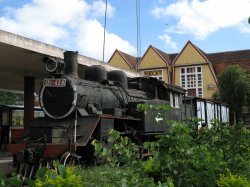
Following that, we drove to a silk factory which was almost worth the trip alone. They take the cocoons that the worms they raise spin and soak them in hot water. They're cleaned somewhat there and a bit more before given to another woman who, while keeping them in hot water, collects them and bunches them together onto a winding spool where they slowly are unwound from the cocoon, wound to a thicker thread, and spooled. These spools are dried and tied by a woman with incredibly fast hands and then either sold or fed into a machine that weaves patterned sheets based on a punch card system. From start to finish it was an enlightening and interesting process. From there back up to Dalat and the Flower Garden, which was not worth the price of admission, around the lake, and to the railway station. It was built by the French a hundred and some years back and is Vietnam's oldest station, with a similarly old steam engine parked on one of the platforms. Grandpa, I thought, would love this. And finally, back to my hotel and past what has to be the largest collection of kites flying on a Sunday afternoon that I have ever witnessed. There was no occasion, no festival, just every kid and their dog had a kite and was running around the park somehow managing to remain untangled. I was in danger of becoming quite tangled in Dalat however, and so I had my dinner that night and booked passage to the coastal city of Nha Trang four hours downhill for the next morning.
Somewhere, five hours north of Saigon lies a quiet town tucked between giant sand dunes and an endless sandy coastline. Somewhere in that small stretch of green surrounded by blue and red, a young Canadian fellow by the name of Dean has disembarked from a bus and is speeding on the back of a motorbike towards a cheap hotel. He has arrived here rather randomly, after seeing a few pretty photos, and doesn’t have long in his time budget to stay. He is prepared to ignore this budget, should it prove necessary, as all good travelers must, but after finding cheap $5 accommodation on the beach at the Saigon Café, he has lunch, rents a motorbike for $4, and endeavours to explore the blue and red regions surrounding him.
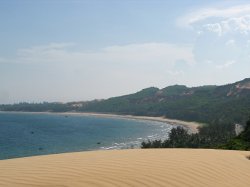
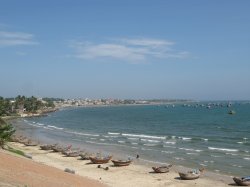
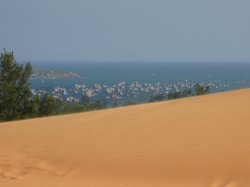
The first stop is what he believes to be the white dunes. It looks rather unlikely – yes, the sand is white, but there’s scarcely more than a single set of prints going up the slope and a 1.5m retaining wall to scale. It’s hard to believe this is the place, but some locals assure him it is, and he trudges up. It later was revealed that no, the white dunes are twenty some kilometers away, but the view up here is probably far superior to what he might have seen there anyway. The rolling sand dunes are untouched and drop off into a blue sea littered with a hundred fishing boats. Small as ants, motorbikes silently crawl their way up the coastal road and the white waves disappear into the coastline in a peaceful rhythm.
On the way back from a drive into the countryside and the white dunes towards red, Dean’s bike coughs once and goes silent. Aside from the road arching up over a hill, there is no sign of civilization as he maneuvers the bike onto the shoulder and attempts to restart it fail. A young boy biking by stops to lend a hand to this hopelessly incompetent tourist and discovers that, contrary to the bike renter’s assurances, there is NOT enough gas to see everything there is to see in Mui Ne. The bike is without fuel, the sun is without mercy, and Dean is without a hat pushing the bike up the hill and making sounds he hopes are curses in Vietnamese – or, failing that, some language. Thankfully, it’s not more than a kilometre back to town and what goes up can roll down with minimal effort. The bike-turned-scooter is half rolled and half pedaled to a small restaurant where they see him coming and bring out a 1litre bottle of gasoline that they can sell at 25% more than the going rate. A pretty fair deal, when they know that he has no choice but to refuel.
A litre of fuel for the bike and a litre of water for Dean and he pays the 25,000 dong. The mother of the family running the restaurant nudges her 7-year old son and he ashamedly holds out his hand and says, “Mister, money?” There are a lot of things Dean would like to say about their corruption of their son and about work and money, but he finished his water, sets it down, and trudges up the red dunes. A young boy doggedly follows him up into the hot sun and the desert, ignoring protests that no, Dean would really rather not ride a crazy carpet down the sand dunes. They go slow, stop, and you end up full of sand with little to show for it, he knows, but the kid presses on. Thinking back to the other child sitting back and holding out his hand, it’s hard not to admire – if not feel pity for – this young boy working so doggedly for a bit of cash. So Dean gets to the top and pays for the ride, slowly slides down the giant dune and winds up at a standstill halfway down and covered in sand.
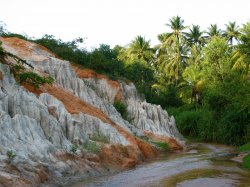
The final major stop is the Fairy Stream. The hour is now 4:30 and the sun will set in an hour or two, so this should allow just enough time to travel up to the waterfall at the stream end. More children attempt to follow and serve as ‘guides’ but give up eventually. Dean is glad for this, as he can quite capably walk up a stream on his own and the kids were just getting in his photos anyway. The stream is another example of colourful Mui Ne, walled as it is by green palms catching the late afternoon sun while the stream itself is mostly shaded by a massive wall of hardened red and white sand. At the end, he manages to find the waterfall and a way to the top but discovers there is little else to see and turns back as the entire stream is now covered in the hillside shadow. Back in town, there is very little by way of people as well, and so after a nice barbecue dinner of some of the fishermen’s bounty, he informs his guesthouse he will be leaving the next day and books a ticket for Dalat, a town high in Vietnam’s mountains.
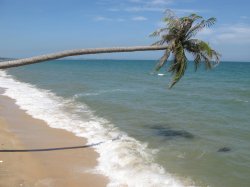
After having paid for the ticket at a travel agent, the agent calls his guesthouse to inform him that there is not a 7:30 bus as promised but only a 1:00 bus. Quite a nice scam, because there is no way he’d book a bus in the middle of the afternoon for a short trip up the mountains (4 hours) losing an entire day. But an opportunity was provided to spend the next morning on the beach and exploring the blue side of Mui Ne. And at 1:00, a bus spirits him away to the next unscheduled stop on the itinerary, somewhere he knows nothing about but hopes will be worth the trek. It’s not exactly on the way or out of the way, but the short trip to Mui Ne turned out to be well worth the day and a half and he has hopes for more inadvertent adventure on the road ahead. And, somewhere in the recesses of his mind, he hopes you will join him there.
The small plane flew over the flood plains of central Cambodia, the green rice paddies of its western borders, and down to the sprawling city that was Saigon, Ho Chi Minh. From above, it was an interesting study in organic urban design. Streets sprawled along paths of least resistance between commons and the rest, it seemed, sprouted from those in random directions as the buildings alongside grew fat on the traffic of the more successful roads. I was in jeans so that I wouldn’t have to pack my large shoes in my backpack and a long sleeved thermal top to protect against the air conditioning. At 31 degrees in Vietnam’s largest city, both would prove a bit warm. Waiting at customs, an English girl came up to me asking if I was Dean. It turned out I had met her when I was hanging out with James in Siem Reap, however briefly, though I not only didn’t remember that her name was Sanna (short for Susannah) but I couldn’t recall her face. Having quickly admitted this, we passed easily through customs, grabbed our packs, and headed out to negotiate our way into the city’s heart.
We grabbed a taxi for $3 and he drove about 20m before stopping and asking for the money up front. We refused and were about to leave the cab when he grunted and started driving forward. Then we got to the gate and he wanted $5 from each of us to pass through. This hadn’t been negotiated and I felt pretty certain that was steep so we did exit the cab and walk out of the airport roads on foot. On the other side, two motorcycles were waiting and I managed to get them down to 40000/bike ($2.50) but Sanna wasn’t interested in hauling her stuff on a bike so we went in a metered cab. After all our work to avoid being scammed, we went in a metered cab. Of course there’s nothing legitimate about these meters. The second you’re not looking they jump from 60000 to 90000 dong, when the whole ride is supposed to cost about 50000 in the first place. So, our taxi cost $14 in the end which isn’t a lot in the grand scheme of things, but we were charged almost five times the real price and the jerk had the audacity to insist we were short changing him on the currency exchange.
I parted ways with Sanna pretty quickly as she is traveling on vacation money and so is quite happy to stay in places well outside my budget – nevermind transport. I found a place for $8/night right off Pham Nga Lao in the backpacker district, one of the cheapest I could find though quite expensive by my standards. It was at Godmother’s and I liked the staff and the godmother as well. Then I met with Sanna for a late lunch and we began our explorations right away. It’s interesting seeing how other people travel. She had her guidebook in hand, something I almost never do, and it made for a pretty efficient walk to our destination, the Temple of the Jade Emperor. We kind of did a combination of getting the general direction and landmarks en route with choosing streets by feel and rough general direction. It was a good mix and we crossed some interesting shops and other temples en route. The Jade temple itself wasn’t remarkable from without, but inside was great. Incense clouds gave the temple a smoky mystique as most of the light was from candles or streaking through the haze to shed a soft light to the rooms. Everywhere, some very human-looking papier-mâché figures watched with a decidedly sinister gaze.
Making our way back without the map was entertaining. It occurred to me that Saigon might have an English cinema in which I could finally see the new Indiana Jones movie, the Kingdom of the Crystal Skull, so after taking a look at Notre Dame cathedral – yes, the French influence is quite strong here – we saw the movie at Diamond Plaza. And I don’t know what the reviews have been, but I really enjoyed it. I admit that it seemed a little more formulaic than the others as well as more unpredictably unrealistic, but overall it was good fun, full of archaeological lore, and action. Did I think Indy should get married? No. Am I glad the hat didn’t end up in Junior’s hands? Yes. Not that I’m so against expanding on the franchise, but there’ll only ever be one Indiana Jones. Perhaps this is how people felt about Bond once upon a time?
The next day was another early one as we headed out to the Mekong Delta. I had been following the Mekong River all the way from the Myanmar-Thailand-Laos border where the mountains of China can be seen in the distance. I spent two days on it from the border of Thailand to Luang Prabang in Laos and ate fish from it while in Vientiane. I slept on an island in Si Pha Don in the south of Laos where the Mekong swelled to 14 km across and crashed on all sides and I sat and watched the sunset on its banks in Phnom Penh. And now here I was at last, where the river meets the sea, where the path of my journey opens and spreads around the world on oceanic currents. But I will not be leaving Asia on these currents, at least not yet. A trip north through Vietnam and China (two countries that I suspect have a lot more in common with each other than anywhere else I’ve been) begins. We took a boat from Saigon down to the Mekong Delta which was the perfect way to conclude it, and then wandered around in that very vast area. In truth I could’ve spent days crisscrossing the delta but we had one and spent it take a little gondola ride among some of the islands, seeing coconut candy, cream, and milk being made, riding bike through the villages, and wandering the markets.
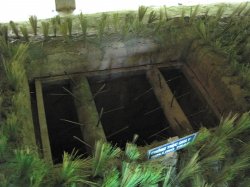
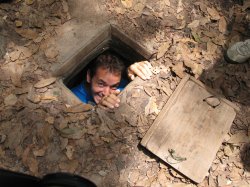
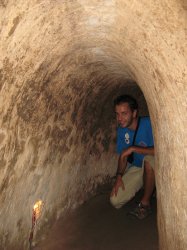
Back in Saigon, I went for dinner with several of the people from the tour at my guesthouse and then for bia huoi (fresh/cheap/draught beer) on one of the small streets nearby. Some of us made plans to investigate the Cu Chi tunnels, where the Viet Cong had really harried the US troops and found ourselves watching a propaganda film the next morning. Cu Chi; A land of peace, love, and the friendliest people on the planet. Cu Chi; A land where honey soaks the valleys and the sun basks local cherries to plump perfection. The picture is painted, rather without subtlety, and then come the satanic Americans and lay the whole thing to waste, throwing out their backs in hearty maniacal laughter as bombs fall from B-52s and childrens’ tears leave craters in the barren earth. After 15 minutes on the unmitigated evil of the US and heroism of the Viet Cong, the show is over and it’s time to go look at some of the horrendous traps that were hidden in the ground for Americans coming through the forest. Spike traps and rolling wheels that pierce groin and belly. I’m not meaning to take sides in this at all; even after all the museums I’ve visited I still don’t feel I know enough of the story. I just hate propaganda, whatever the source.
Reaction aside, the tunnels, like the traps laid for the Americans (and I should add Australians, New Zealanders, Thai, and French) were ingenious. They had systems and levels to keep the water out. They had clever designs to disguise the entrances. And they were designed to make traversing them simple for Vietnamese and difficult for Americans. The latter is a nice way of saying they were built small. I wandered through some of the tunnels and was bent half over trying to cross them – and I wasn’t carrying a backpack or any military gear. Then out of the tunnels and up for a quick drink at the café while AK-47 rounds were being fired nearby with incredible loudness and back to Saigon. I jumped off the bus home at the War Remnants museum and took a sobering look around there. The propaganda here was more subtle, but that didn’t stop scores of scathing anti-American comments in the guestbook, which I perused while waiting out the pouring rain. I was admiring a tank immediately after entering and three English ladies were talking nearby. One of them was venting at Americans quite vehemently on the Vietnam war and then, when asked by her friend why the US even came to Vietnam, admitted she had no idea.
For me, the point of these war museums is to see one side of the war. Ideally, you’d see an unbiased look at both sides, but such a thing doesn’t exist anywhere I’m sure. Certainly we know that there were plenty of people in the US who were against it and in other countries too, but if you’re only reacting to the propaganda, surely you have a bit more education before you weigh in with your opinions? The museum was enlightening for me in that sense, and I thought about England’s colonial times and wondered how ashamed this woman was of the various horrible things that England had done here in Asia in the name of colonialism. This probably wouldn’t have crossed my mind except that I’m reading a novel called The Glass House about that very topic, following a young Indian boy living in Burma through to his children, grand-children, and beyond. It seems as unfair to write or speak scathing remarks about the Americans – many of whom the museum itself documents as being against the war – as it does to hold modern English responsible for things that happened 200 years ago.
But I digress. A visit to the war museum which was enlightening in an unexpected way and then a completely unguided wander first to Diamond Plaza for a trip to Narnia left me exhausted. And so I returned to my guesthouse and then went to the markets for dinner. Food in Vietnam: I’m still figuring out what’s what, but I’ll say right now that they have some exceptional spring rolls. I know, it’s nothing exotic or amazing, but whether it’s the oil or the ingredients or what they’re wrapped in, they are exquisite. Pho, a noodle soup, is typical fare for breakfast and popular everywhere. At the markets, I had some scallops (which were more like oysters than what I know as scallops) in butter, garlic, and chives; I had spring rolls; I had fried morning glory, and I had two drinks. A veritable feast at a total cost of $6. It is my intent to take a cooking course as soon as I find a fairly reasonably priced one to better appreciate what is going into the food and what makes the really good stuff good.
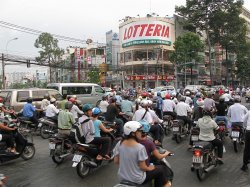
My final day in Saigon I spent wandering the streets, which is a very dangerous thing to do here. Not that you’ll get mugged or anything, no no. You might get pick-pocketed if you’re really unlucky but generally the worst you have to deal with are kids insisting that you need chewing gum from them or sketchy people (all of whom work for the tuk tuk mafia) trying to sell books, carting around portable scales, and you name it. I even saw someone with a virtual aquarium’s worth of live fish making a sale. But these aren’t the dangers either. The danger is crossing. You have never seen such ordered chaos. Motorcycles, cars, busses, all vying for a clear path on the road, weaving in and out, across oncoming traffic and through it, onto sidewalks, you name it. And there is rarely a break in the traffic. What this means is when you want to cross, you must steal a page from the Old Testament and attempt to part the sea. The trick is to cross slowly, making eye contact and looking in the direction of oncoming traffic, and be consistent, predictable, and unswerving. You have to have faith that nobody is going against the flow of traffic where you cross, and you have to know when to turn your head to look in the opposite direction. It is generally before you think, as there is no real dividing line (there is, but traffic’s too heavy to see it and even if you could they still wouldn’t abide by it). Do this well, and you will cross the road. Fail, and a massive bus which stops for no man nothing may be scraping you off the grille.
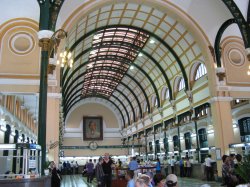
Saigon was an interesting stop and an exciting change from the rest of Southeast Asia. I had been getting a little tired of the inherent sameness of Cambodia, Laos, and the Thai influence there. Coming to Vietnam is a new experience and has recharged my travel batteries. The people so far have been quite friendly, contrary to popular reports, and the city has offered up plenty of interesting activities. My last day found me in the Post Office admiring the train-station type architecture, and at the Reunification Palace taking a guided tour through the three floors of meeting rooms, suites, ballrooms, and bunkers. Mui Ne was next on the agenda, an impromptu addition inspired by a photo I saw in a travel agency and a realization that I had plenty of time to explore Vietnam so I might as well not rush from highlight to highlight. And so I leave you for now, heading north to the beach and beyond.
Ten hours of uneventful but leg-numbing bus ride from Shianouk Ville is the north western town of Siem Reap, a city famed for its proximity to one of the marvels of the world: Angkor Wat. I had hoped to escape the rain but arrived in the middle of a deluge that had flooded streets everywhere in ankle to knee deep water. The poor soul who drove me in his tuk tuk from the bus station was shivering in the rain and soaked and, wouldn’t you know it, we broke down in the middle of a giant puddle. He jumped in the dirty water and fiddled and played with his bike as the rain fell from the blackness above and traffic swerved and honked around us, but finally got it going again and drove me to the Garden Village Guesthouse. It was recommended to me and indeed, wasn’t too bad, but as I didn’t make any friends there or even use their restaurant/bar, I think I would’ve been better off at my first stop, Green Inn, paying $1 for a beautiful room not much further distant from town. I arranged to meet my tuk tuk driver in the morning to check out Angkor Wat after finally settling and sheltering from the rain.
It had been a long journey, and I was hungry. I was also hoping to meet some people, so I wandered back in to town (a tuk tuk driver heading that way gave me a free lift to the ATM) and found a cheap restaurant with some friendly staff to grab a bite. While there, I ran across Beth, an English girl I’d run across any number of times as far back as the slow boat to Laos, and two other guys and joined them. The four of us went out for a beer or two at some of the pubs on Pub Street, the Khao San Road of Siem Reap, and called it a night – or so I thought. Walking back towards the guesthouse I heard “Katsiris!”. Well, it’s pretty rare I know someone well enough to have them know my last name, and I turned and looked and there was James walking towards me. James is a friend I’d met in Vang Vieng, Laos, rock climbing and we’d talked about doing a rather adventurous kayak journey down the Mekong. So another few beer and he told me all about his journey and that he had indeed done the boat trip about a week after I continued on. And it sounded amazing. He talked about being taken into villages and fed and sheltered, some rough spots on the river, and it all sounded rather epic. If only he’d been willing to leave sooner, I would’ve been on that trip, too, but I have to say that even knowing I wouldn’t have wanted to wait a week to depart I still regret that I missed that.
The next morning came all too early but I was speeding off to Angkor Wat with my tuk tuk friend by 8:30 that morning. I’d checked the weather forecast the day prior and today was the only day with a low probability of rain, so I took it. The sky was overcast but it wasn’t too hot nor raining so I was thankful even if I knew my pictures wouldn’t be too fascinating. A good excuse to use black and white, I decided, though I kept colour where I liked it. Angkor Wat is just one temple among many around Siem Reap, most famous because of its size, or perhaps for its art surrounding the outer walls. Or rather, the outer inner walls. The complex is a giant moat with a stone bridge crossing to the temple and then some gates and walls – some sized for elephants others just for people. It was originally a Hindu temple, and thus reminded me a lot of Prambanan in Indonesia, but had been converted for Buddhist usage years later (16th century), so there was evidence of both religions all over. And though it was indeed impressive, and I spent a lot of time admiring the building, frescos, ruins, and spires from inside and out, it was not my favourite temple.
Rather, I found myself drawn to the others more so. I really liked the hundreds of faces carved into stone at Angkor Thom, and the promenade up top around the central spire. And best of all was a fairly ruinous temple called Ta Phrom, which had mixes of volcanic stone, green moss, vine, and tree overrunning everything, and white rock. The ruin added something indescribable to the temple’s mystique; you felt like you were uncovering something rather than visiting a tourist site. And there is a beauty in nature’s slow reclamation of mighty ancient human efforts, of seeing a building of stone, so solid and immovable, being infiltrated by an army of tree roots seeping into its pores. Or perhaps it’s that the two, man and nature, are coexisting at the moment. In either case, the temples around Siem Reap offered many rewards and far surpassed my own rather skeptical expectations. I returned home mid-afternoon with my legs absolutely exhausted. It was not so much the walking that got to me as the stiffness from the previous day’s cramped bus ride. I even contemplated a massage and in retrospect it would’ve been the perfect time to get one but instead I relaxed for a while.
Later that evening, I went out and had dinner at the noodle markets. I was sitting next to some Americans and wound up joining them for drinks afterwards and having a great night out. I showed them some of the local bars, we got a deck of cards and had a good night of it. One – Nick - was a Navy SEAL, Evan an ex-Canadian (from Winnipeg) living in California, Gabe a Californian through and through, and Kerri, yup, another Californian. They had come from Vietnam and gave me some pointers and I am pretty sure I sold them on Laos but aside from that it was a pretty travel-free conversation for the bulk of the night and that is a very nice thing when travel plans and history have replaced the weather as primary topics for small talk. My final day in Siem Reap was rainy so I didn’t go out to the Floating Market. I think this was probably a mistake as I have since heard people raving about it, but I didn’t make it. To be honest, I think I needed a change of scenery. While I’d love Angkor Wat, I just wasn’t excited about Cambodia. I think I was still trying to work out how to fit the Philippines into my itinerary, and so I did the only logical thing. I went and booked a ticket to Vietnam for the next morning. Once I entered Vietnam on my visa I would be forced to see the country before I could go elsewhere and that meant it would be too late for the Philippines. That meant I wouldn’t have this nagging “every day wasted is a day I could be in the Philippines” feeling. And so, with a few last Khmer dishes under my belt and, finally, a quiet night, I was off to Ho Chi Minh (Saigon) on a plane the next morning.
Shianouk Ville, on the southern coast of Cambodia and near to the Vietnamese border was all of these things. The rainy season was definitely in swing, with lightning storms blowing across the water to soak the small resort town three times daily. I had hoped to get a little beach in, having been in city, town, or wilderness for the past two months traveling inland Asia, but instead, just relaxation and a respite from touring. The first two days of this were spent with a mild food poisoning from our food stop en route, and coincidentally, those were the only two days with fair beach-going weather. As for the ghosts, well, as a result of the inclement weather, there were not many travelers around to be found, and what few there were, at least in GST Guesthouse, seemed discouraged enough at the lack to take solace in HBO. But it was a quiet and relaxing time, I recharged my batteries and wreaked havoc upon my laptop’s. Eating was an outing and a way to pass the time, and I would sit at a beachside restaurant eating BBQ Baracuda or some equally delicious snack and watching the evening thunderstorm blow in from the sea. I took no photos; it was a camera vacation. I’d’ve loved to have gone to Otres Beach and spent the day, but there was no traveling; it was an inadvertent touring vacation too. And in sharp contrast to other locales, there are no stories; it was a blog vacation. Normal programming will return in Siem Reap.