Fresh from the Galapagos we made a mad sprint to get to Cuenca the same day we had woken up at 5:45 AM to visit North Seymour Island and flown to Guyaquil from Baltra at 11:40/12:40 (Galapagos/Ecuador time). It couldn’t have gone smoother in Guyaquil and within 20-30 minutes of stepping off the plane we had gotten to the bus terminal (very logically located very close to the airport), bought a ticket for a bus leaving in ten minutes, and made our way up to the third level and our seats on said bus. The trip was just shy of five hours and though we arrived in the dark we got a taxi for $2 without even having to do the whole “we KNOW the price it’s SUPPOSED to be” routine to Hostal Paredes (now called Majestic). It was a pretty nice looking hostel, maybe even majestic, that is until he turned the corner to our cheapie $10 room. We should have looked a little more carefully but you’re always a bit more eager to take a place that looks remotely clean and cheap after dark. It was about as secure as a door on a chain with a piece of flimsy 1/8” sheet board covering the space above where the doors didn’t bolt closed. We decided before we left to grab dinner that we were going to have to look for somewhere else tomorrow morning. Monday night at 9PM, it turns out, Cuenca is deader than Riobamba on Good Friday so it took some time before we found a place to eat but we got some hamburgers to last us until morning and finally got back to the hotel and collapsed by 10. It had been a long day.
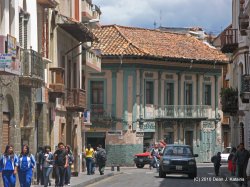
The morning came and I felt terrible with another feverish sleep and general achiness but two ibuprofen, water, fruit salad, and lemonade did a good job of diminishing that. On top of that, it turned out that Cuenca was even more beautiful than I’d heard; marble churches, sprawling monasteries, graceful and well-maintained colonial buildings, and clean streets. It is said, at least by the Lonely Planet, that Cuenca and Quito are often in competition but that’s doubtful. It is unfair to compare anywhere I’ve been so far in South America to Cuenca except for Cartagena which still holds the number one spot for me. Cuenca is just too much of a charmer. We found a hostel amidst the gawking called Monasterio and for $7/night instead, it had Wifi (two weeks in the Galapagos meant I’d be using that particular service quite a bit), big beds with actual firmness/back support, and a private bathroom that some German dude hadn’t defiled by coming home drunk, spinning around three times with the lights off, unzipping, and going to town. Done and done. And we didn’t know it ‘til later as neither of us was quite ready, but $1 big Pilseners [sic] too! Back to the Majestic Hostal, which by the way had refused me a Dixie cup of purified water to take some painkillers because I wasn’t staying in one of their more expensive rooms, we grabbed our bags and walked back. The sky was clearing from the morning’s overcast and I felt my mood and illness lifting in coordination with it.
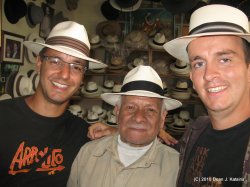
In fact, I even grabbed my camera though I decided today to just let Bjorn deal with where to walk and I’d follow him. So we went through the old town and passed a place called “Casa del Sombrero” where probably the most famous maker of Panama hats (which actually come from Ecuador and are called Montecristis, muchas gracias) in the world, Alberto Pulla, has his store. I mean, the man is even on Tourism Ecaudor posters. It is so great to see someone who really loves what he does and what he has been doing for probably the last 60 years or more. He’s likely into his eighties and although he has almost completely lost the ability to speak I can’t imagine his smile has ever been bigger. He gets downright excited finding hats for people. We looked around for a bit and talked with him – I’m not sure how but I could understand him pretty well and wound up coming back the next day. I definitely had no intention of buying a hat but the next day I walked out with one of his own handmade ones keeping the sun out of my face and had promised him to send a postcard for his sprawling book of thank-you notes from all over the world. I couldn’t even bring myself to bargain with him, though whether out of respect for his life’s work, sympathy for his lost voice, or just appreciation of the smile is unclear.
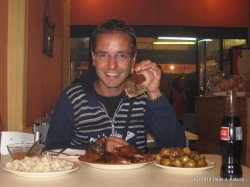
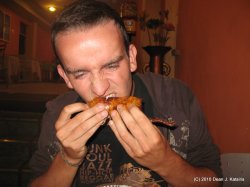
Aside from Cuenca’s beauty, which occupied most of our two full days there, and the Panama hats, there is still one more thing Cuenca is famed for in Peru: Cuy. In English, that is munching on a whole guinea pig. Bjorn and I took a cab (again, no attempts at ripping us off in either direction, so nice!) down to Don Copal Street where there are several restaurants that specialize in it. I’m going to warn you, of the weak stomachs, that the photos at the end of this blog may well disturb you. We arrived and checked out a couple of restaurants: I had heard that they generally fried them whole, with the professionals using no less than six different oils of differing temperature to get it just right but here they were cooked on a spit. One lady offered us a taste of some apit-cooked pork that was spiced quite nicely so we sat in her restaurant and ordered a guinea pig to share between the two of us. The cost for a medium-sized one with a big plate of the flavourless white corn they serve here and some potatoes was $12 and before we knew it, our little creature arrived at the table, already chopped into sections with paws and teeth poised as though he might attempt to eat us instead were we not careful. I picked up the right side by the little paw and took a bite. Or rather, I tried.
Although I didn’t think I found it all that disturbing, my eyes fell on a small patch of fur that hadn’t been removed as I attempted to tear some skin between my teeth and I just about lost it there. I fought down the gagging with some Coke and potatoes and tried again, a more meaty part. I managed to get some down though there wasn’t a lot of meat to it in the first place. Then, as I picked apart the ribs to get at the meat there I tasted some really off-tasting meat and just about lost it for the last time. I got up when I was able and asked for a small portion of pork, both surprised and disappointed by my weak stomach as I sat back down and looked at the guinea pig’s head with mouth wide open and incisors polished. The meat I did manage to get down wasn’t particularly tasty though it definitely had its own taste, but it is considered a delicacy here and many families have a cage in the corner of their kitchen to raise the little guys for a feast. Me, I wouldn’t bother. The pork was just fine although I was further surprised to learn that gagging three times had stripped me of my appetite. Bjorn finished the Cuy thankfully and we took a cab back to our hostel for some beers on the rooftop patio. The next morning, he would leave at 5:30 for Quito and then Spain and I would leave an hour later for the Peruvian border and beyond, so this was the end of our 3 weeks traveling together. He may have terrible taste in movies but we had some great times and I look forward to toasting our success in Cotopaxi or the Galapagos sometime in Iceland over some hopefully not overfished/endangered traditional whale in the future. If I can get it down, that is.
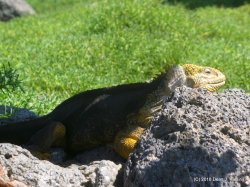
We were winding down our last days in the Galapagos. Our guide, Enrique, was a super nice and really soft-spoken person and I felt bad that he had to deal with a German guy and a Swiss guy who really had no respect for him and would venture off the trails, snorkel where/when they weren’t supposed to, use flash photography, and so on. They didn’t seem to mind that they put his job on the line every time they did so. The Polish girls, while friendly, were also a bit of a handful in that they would talk when he was talking and interrupt with jokey questions like, “Well how can we know FOR SURE that the rats are vegetarian?” It probably didn’t help that I wasn’t feeling especially well, with a sore throat (crazed air conditioner or snorkel bacteria?) headache and sore muscles. In any case, we had sailed overnight and arrived in Santa Fe island that morning, in a protected bay surrounded by rock. This island is pretty close to Santa Cruz and is popular with day trippers but one advantage of arriving early was that we had it all to ourselves for a few hours. The beach, again, was littered with sea lions and up the path we got a good look at some land iguanas, which, unlike their marine iguana cousins, are not doing so well. Bjorn had observed that up until now whatever our guides had not failed us: whatever they wrote on the board at least one person in the group saw. However, today’s list had an ambitious amount of birds like yellow warblers and a Galapagos hawk not to mention endemic rats, none of which we came across. Still, it had been a pretty good streak. After our short walk we came back on board and went over the side with our snorkelling gear.
I laid down a bit before heading out with everybody else. So what was the best snorkel for most of the group was just a decent one for me. They saw shark after shark as they got in the water but they had finished their morning snack and gone when I arrived. However, I’m pretty sure I saw (there was no way to miss it) the biggest school of fish I ever have seen or will see. From the surface it looked like rocks because it was a huge patch of black but in the water it was probably millions of black-striped salema, another native fish. I watched a SCUBA diver ‘freefall’ into them very slowly and instead of scattering they slowly opened up a spiralling vortex (widest near the top and closed at the bottom) and as he passed through, closed behind him and swallowed him whole. I did the same, although I couldn’t hold my breath long enough to have them fully cover me and tried to take some photos then a friendly SCUBA diver offered to take my photo. I signalled I was out of air and would come back and he waited for me to catch my breath and plunge down 10m to hand him my camera. Pretty nice! The rest of the snorkel was more tropical fish, a bit of playing with sea lions and amazing blue waters. Because it’s so well protected, the visibility was more than 15m.
From Santa Fe island it was a short haul over lunch to nearby South Plaza, from which you could not only see North Plaza but also Santa Cruz and Gordon Rocks, where I’d SCUBA dove so long ago. This island had some really cool cactus trees, more land iguanas, and yet more cliffs. We also came across a sea lion skeleton bleached white in the sun right beside the decaying remains of a land iguana. Hopefully not a portent for the future. There were plenty of other things to see here, too, but of course we’d seen most of them already. This was becoming a common theme for the second last day of the trip. We drew a bit of a short stick in that, for the third time on our voyage we had to go get more fresh water. Usually that was done the next day, or at least it was when we first boarded and if it had been we would’ve already been flying back to the mainland when that happened. That said, it gave us a really spectacular last evening on board. First we had a really nice dinner and a farewell cocktail, were finally introduced to the crew (strange to do this on the last day instead of the first; I actually knew more of the crew’s names than our guide by now), and then went on deck. First there were flying fish jumping in and out of the water. The sea lions came and would very occasionally sprint after them. For such lazy creatures, I have never seen ANYthing move so fast. Pelicans, of course, were there all along occasionally swooping from their perch on our bow to grab a fish or two.
What had brought us out first though were the Galapagos sharks: there were a few of them circling us. As the sea lions came (the two animals are definitely not friends) the shark numbers escalated. Soon there were around 8, and before we knew it, 20-30 of them. The skeleton we had seen that afternoon was probably from a sea lion that had been fatally wounded in such an encounter as this, so to see them both swimming together was rather tense and we thought at any moment there would be an attack. They’d swim close to each other and usually the sea lion would veer off and the shark might also veer slightly but wouldn’t chase it. Apparently the sea lions are faster in the long run. Then there was once where a sea lion and a shark were swimming a head-on course and as they grew closer everybody came to the one side of the boat. The distance closed at a frustratingly lazy pace and they came nose to nose before each veered in the opposite direction, equally lazy. What was going on here was beyond me. Did the sea lions know the sharks weren’t hungry? Was it a size issue where both shark and sea lion knew that the sea lion was too big for the shark? Still, there were 30 of them, you’d think there would be a fight somewhere but no. It was still cool to watch but I was feeling tired and sick and thought it might be in my best interests to go below although I was SURE as soon as I did I would miss the action. I convinced myself any chase would take the action far from our lights and we’d not see anything, so I said goodnight, told everybody that as soon as I went down they’d see a manta ray (and to thank me in the morning) and went below.
I don’t know if I’ve written it here or not but there are three things I’d really love to see SCUBA diving: whale shark, manta ray, and octopus. And I’d be quite content seeing a Manta Ray from the surface, too, and had made this remark more or less every night. So when I was downstairs, just getting undressed, and Bjorn came downstairs and said “Manta Ray” breathlessly no more than three minutes after I’d said goodnight, I didn’t believe it right away but nonetheless was still zipping up as I stumbled the last few steps onto the deck. He was gone and I was bitter. In the three minutes I’d been below I’d not only missed a Manta Ray swimming by the boat but also, apparently, a bit of a scrap over a fish that a sea lion had caught – the blood of which had brought out a virtual school of sharks. I stayed up there for another half hour but nothing else happened and I went to bed dejected. It was now our final morning and I had not slept well as I had a fever and a bizarre dream in which I read a “children’s book” about a guy going around the world in a flying car that was laced with communist propaganda and words like “Proletariat”. I remember thinking in my dream, “Who on earth is going to read this?” but then the end came and it turned out the book was written by a soldier in World War I and this was HIS dream for the future. So then I woke up and in my fevered state wondered whether I would someday encounter this book and what I would do if I did and couldn’t shut my mind off of that.
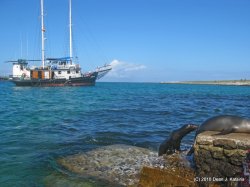
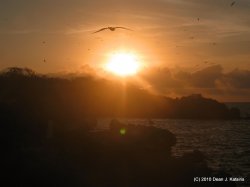
But I digress. It was our last morning on the boat and for that matter in the Galapagos. Enrique was waking us up at 5:45 AM to go ashore on North Seymour island and walk around before heading for the airport. I was very seriously considering not going but I dragged myself up and out. It was an important stop for those who were only aboard for 5 days as it was their only chance to see frigate birds, but as you know, I already have plenty of photos of frigate birds not to mention everything else on the island. They were lucky to see a solitary red-footed booby, usually only viewable in Genovesa, and there were still other creatures to photograph including some mating blue-footed boobies, but my camera only came out for the sunrise, a final photo of Angelique, and a photo of a gull and a sea lion together. Not that it wasn’t nice, but how many photos of the same thing can I have? Back on board, I managed to down a pancake and some fruit and then we hauled our stuff up, said our goodbyes, and Enrique brought all but three of us to the airport. A three hour wait and we were on a plane, flying away from the Galapagos as all the many strange species of birds below us had never managed, and on our way to Guyaquil. The plan was to try to get a bus ASAP for Cuenca because Bjorn had only a bit of time left before heading to Europe and I needed to get back on track for making Buenos Aires by July. It went flawlessly. We got off the plane, got our backpacks and walked out the terminal just in time to catch a passing local bus to the bus terminal. At the terminal we got tickets for a bus leaving for Cuenca in ten minutes, just enough time to get upstairs and to the bus, and got it for $6 where the regular price is $8. The man boarding asked where I was from and when I said Canada, he said he’d like to get there someday. Something in the way he said it sounded determined rather than dreamy and I replied that I was sure he would. You’d better believe it, he said, and we were on our way.
A few of our new passengers had been worried about the trip that they had booked. Was that first day in the highlands of Santa Cruz an example of what the rest of the days held? We couldn’t guarantee anything, the Israelis and us, but we told them that every other day on the trip had been great. The plan for Friday, their second day aboard, was to arrive in Floreana, one of the older islands in the south of the archipelago, and after a short trip to the old Post Office Box and a pirate tunnel we’d be snorkelling. Then it would be lunch time, and we’d go around the island to one of the best snorkelling sites in all of the Galapagos at Devil’s Crown. There’d be a short break to check out a flamingo lagoon and then go snorkel some more off the beach. With all that snorkelling, three times in all (hence the Springsteen reference) what could go wrong? The Post Office box was pretty cool – there were stack upon stack of postcards, most of which were from the US which is surprising considering that we’ve met no Americans here on the Galapagos. Someone in the group remarked grumpily that the Americans never wrote their country on the postcards which I had to laugh at: surely EVERYbody in the world must know the TN means Tennessee, USA? Or CA is California and not Canada? As I looked through the postcards I saw this was mostly true. I digress, however; the post office box was a place where passing ships would leave mail going in a different direction and pick up mail in the direction they were headed. Today, people leave postcards and letters for home and if another traveller comes across one for their home they hand deliver it. I found one, and in fact was the only person in our group to do so, from Saskatoon. It said simply “Hotter than Hades - Dick” and isn’t properly addressed but I’ll try to find its recipient when I get home. Hopefully someone will do the same with mine.
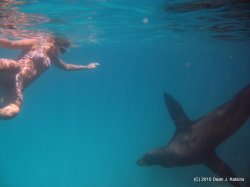
From there we walked, as promised, to the pirate cave which actually connects on the other side to the sea. The first resident of the island, an Irish guy, used to use it to store rum that he got by trading pirates for vegetables he grew. Pretty good bargain all around, I’d say. No scurvy for no boredom. At last it was time for snorkelling and unfortunately the visibility was very poor. On the plus side, one of the Swiss had an underwater enclosure for the Canon G10 that didn’t fit his G11 but passably fit my G7 so he let me use it in exchange for whatever photos I might take underwater. The visibility wasn’t that great but I did manage to get some cool photos of a sealion that was playing with us. I also saw a baby scorpion fish swimming right in front of me which was something I’ve never seen before. We went snorkelling again on Devil’s Crown, which is a caldera of rock offshore and the snorkelling was much better there. In fact, there were three snorkels that day which was pretty cool – snorkelling was quickly becoming my favourite part of the Galapagos because there were a larger list of things I hadn’t yet seen. On land, I could pretty much cross off all the birds that are endemic here and all I really had to see yet was some tortoises in the wild. In the water however, were turtles, sharks, manta rays, and so on. And having a camera made it new again, in a way, because now I wanted to get photos of all the things I had seen as well.
We maximized the day by going back to the island on Cormorant Point and staying right until 6:00, which is the latest you’re allowed to be on the island. We walked past a flamingo lagoon and to another beach where turtles come in to nest but the surf was too much to see them so we wound up looking at crabs instead. I figured that since I had my crab photos I’d try to be arty and use a slow shutter to make the water wispy but with limited success at best. Then we walked back to the other side and had one last snorkel in very poor visibility where I saw basically nothing. That said, I did have an interesting encounter with one little fish (maybe 5 cm long) that took a liking to me and swam all the way up the rocks and then back to the beach. I felt bad leaving him alone in the water, little Nemo, after having him swim most of the way right in front of my mask, but there was nothing to be done about it. Hopefully he’ll be alright. We sailed that night to Espanola Island, which is the oldest island that we can visit and probably the nicest beach we’ve seen here in the Galapagos, which is saying something. That is, of course, if you don’t mind sharing it with the many sea lions and marine iguanas. Just off Espanola was some of the best snorkelling I have done, too. I found a tiger snake, a Mustard Ray, and best of all, a Green Sea Turtle. I’d had to go a little out of the way to find the turtle but it was worth it and I got some exciting photos with the incredible visibility. On the afternoon landing we took a walk around the island and enjoyed beautiful views from the cliff tops not to mention crossing the last major bird off our list: the albatross. These two days definitely kicked up the second half of the trip a serious notch and we were again excited for the remaining few days. Be sure to view photos from this island, too, as they are some of my favourites from the Galapagos.
It was early in the morning when we were roused from our sleep to embark on the next adventure. We were anchored in Sullivan Bay off the coast of Santiago Island with its sprawling black landscape punctuated by mounds of crushed red rock glowing in the morning sun. To get onto the lava before the day got too hot we were delaying breakfast and setting out at 6 AM in the zodiacs. True to Albarro’s word, the lava rocks were already warm and our walk took us along many different patterns created when the lava had cooled some time ago. The islands are formed from a volcanic hotspot as the tectonic plate moves southeast to slip beneath the continental one, which means that the islands in the northwest, like this one, are among the youngest in the Galapagos. That is one of the reasons there is so much diversity in landscape from island to island. It was a really nice walk first thing in the morning but to be honest there’s not much to discuss except for volcanic rocks in shades of black, red, and sometime yellow and numerous crevasses and cracks from when the lava cooled. We saw no life except a few plants struggling to break down the rock into soil for other less hardy plants to follow and a few lava lizards here and there. From the latter of the two, which is to say from there, it was back to the boat for breakfast and then we set out on the pangas (zodiacs/dinghys/etc) to do a cruise or nearby Bartolome Island which was a satellite eruption from the Santiago volcano.
Bartolome is a much smaller island which makes it all the more ironic that it was far more fascinating. Most of it is ash and thus life has taken a much firmer hold than on its larger neighbour. There are two beaches, one of which is a turtle-nesting zone and the other habituated by sea lions and Galapagos Penguins. Also, the hard dome around the volcano has mostly eroded but there is one section, called the pinnacle, which is stubbornly clinging to life at a precarious angle. From Santiago its silhouette looks like something out of the British version of Planet of the Apes: the silhouette of Big Ben juts out of the beach like a crooked finger dooming humanity. We took our panga tour and got nice and close to some penguins then headed up to the top of the mountain to see the famous panoramic views of the island below us. Its shape reminded me of a smaller version of Ko Phi Phi in Thailand – two beaches in a narrow strip connecting a smaller mound with the larger mountain we were now standing on. We descended and made our way to one beach and snorkelled around the island to the other side in what has to be one of the best snorkels I have ever done. There were sharks, rays, sea lions, coronet fish, puffers, angel fish, and more with visibility so good as to be criminal in most of North America. I can’t describe it well enough to do the snorkelling justice but suffice it to say that by this point a day without a snorkel would seem even more criminal than the visibility.
Unfortunately, that is exactly what the next day, Thursday, held for us. Wednesday afternoon had been spent relaxing on the boat’s upper deck and cruising around Santa Cruz (no pun intended) looking for dolphins, whales, or manta rays while soaking in the sun with a cool beer. Right, like I was going to find a manta ray that easily after all my prior efforts. It was a great day overall (without any of the previously mentioned spectacles) capped with a few more beer in Puerto Ayora with the Israelis and Delphine along for the ride. Thursday was the last day for most of the boat’s passengers: the Swedes, the French, and the Polish were going, leaving just us and the Israelis to continue on until next Monday. The morning was spent at the Charles Darwin Station where they help the sea turtles to breed in a mostly successful effort to regenerate them after we nearly wiped them out. There is one turtle, named Lonesome George, who has not been so lucky however: as far as is known he is the last turtle of his kind from one of the smaller islands and they have had no luck in trying to breed him. Hence the lonesome part, I guess. We did get to see him walking around which, for a turtle of his bulk and age, is pretty impressive. His legs are like elephant trunks and you half expect the ground to shake when he takes a step except that the steps are so slow and ponderous that you’re not even sure you saw him move. Then we said goodbye to everyone, including, unfortunately, our guide Albarro, and had some ‘free time’ in Puerto Ayora before lunch and the arrival of the new passengers.
The new passengers showed some promise. We had two Swiss couples and a lone Swiss guy, an Aussie guy, a New Zealand girl, a German guy, two Polish girls (I’m surprised by the number of Polish here), and two Ecuadorian girls, making the boat full with 16 in total. Our new guide, Enrique, also arrived and he didn’t take long to make us miss Albarro. He’s very very nice, which is, well, nice, but as a guide you need to be a bit more loud/vocal and a bit more of a leader where he seemed more apt to sway in the breeze. When the Polish girls heard the plan for the next day and discovered that breakfast was at 7 AM they almost succeeded in pushing it back (at the expense of the morning activity) with a few half-joking complaints. He also didn’t really lay out the way the boat works or the rules very loudly or clearly which would cause some problems in the next few days with the new passengers. We went that afternoon to do a “highlands” tour of Santa Cruz which was essentially a waste of time, though no fault to our guide there. We went up in a bus to a farmer’s field and walked in the mud whereupon we saw two of the same large turtles we’d seen in the Charles Darwin station. The highlight were two hollowed out giant turtle shells that you could crawl into, put it that way. From there it was to the lava tubes that was a giant tunnel. It’s impressive to think how much magma must have been flowing in this pipe and I’m still not entirely clear what mechanism caused it to be hollowed out in spite of asking Enrique twice, but that’s what the internet is for. When I get back to it. So it wasn’t a promising first day with the new guide but the group seems cool and we have a much more exciting day planned for tomorrow.
After a bit of a wait at the airport with Freddy (our travel agent here in the Galapagos), our guide, Albarro, took us, the Israelis (Erez and Shiri), a French woman (Delphine) and her parents out to the boat. There was not much going on aboard but eventually the current boat passengers – two Poles and an old Swedish couple were top deck. I won’t say we met them, but they nodded to acknowledge that we were on their boat. I had wrongly assumed that there would be introductions later but that never happened. Albarro came to give us the rundown on how the ship worked and then handed out our rooms. Ours was Room 6 or the Galapagos Shark room, and as it happened just after we put our stuff downstairs there were two Galapagos sharks circling the boat. The rooms were really a level above what I was expecting, with hot water and air conditioning that functioned, if anything, too well. It was soon time for lunch and that too exceeded my admittedly modest expectations by quite a bit: there were no rice and beans to be found! Instead, fish filets in a parmesan and tomato melt with steamed veggies and rice. We had to refill the boat’s fresh water reserves before setting out, which took a lot of time, but then we motored over to Bachas beach on the northwest side of Santa Cruz Island and I guess that qualifies as our first stop on this tour.
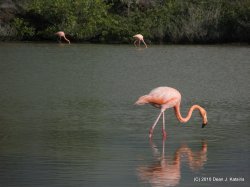
This was a ‘wet landing’ which basically meant that we hopped in the two dinghys and had to hop into the water. Bachas beach was right out of a postcard except without a palm tree to be seen: white sand, various shades of blue waters, black rocks, and life everywhere. While we waited for the dinghy to bring the rest of the passengers I spent some time photographing the numerous crabs watching the surf from the rocks. Then we all set out a short distance to a brackish lagoon with three flamingos in it. I have to admit, I had no idea they could fly; I thought they were like chickens, but we saw one take off and its long neck and wings spread made an awesome silhouette against the sun. I also learned that they feed with their heads upside down to scoop water in their upper beak, and then the water filters out and the small micro-organisms (like shrimp) stay in. After some flamingo watching, we went back to the beach, strapped on our fins, and headed snorkelling in the water. The visibility wasn’t great with all that white sand being stirred up, but Delphine saw a turtle and a few of us saw a baby Galapagos shark, not to mention huge schools of yellow-finned sergeant fish, parrot fish, and the other usual suspects. After a bit more lazing around, it was time to head back to the boat for dinner, which was even more excellent in spite of the fact that the Swedish man attended in his underwear (really), and then had a bit of relaxation before we headed out into the high seas for Genovesa Island on the other side of the equator that night.
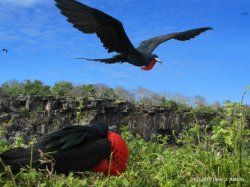
When we woke up in the morning, we were in Darwin Bay, a crescent moon of black cliff face crowned plunging down into the green waters. Breakfast was served and we divided into two groups to fit onto the two dinghies. Unfortunately, I wound up on the second dinghy which was the one without a guide and our pilot didn’t feel especially up to guiding the boat alongside the other. So basically it was a ride in silence though occasionally we would hear Albarro saying something like “can grow to be...” as their boat would pass ours. It was pretty frustrating but he said we’d get the tour on the way back even if I knew that were there a tour it would be abbreviated. All those concerns melted away pretty quickly as we climbed Prince Philip’s steps and came face to face with more birds than I have ever seen anywhere – including Alfred Hitchcock films. Albarro proved again to be a knowledgeable guide and went into a lot of details about what we were seeing: frigate birds, red-footed boobies, stormy petrels, and even an endemic owl. The frigate birds were the favourite by far; the males have an inflatable red chest and perch themselves somewhere solid so that when a female flies by they stretch their wings, lean back, and make a woobling sound to call the ladies down. The male red-footed boobies on the other hand, whistle at the females similar to methods employed by humans near construction sites. We got to observe both types of birds doing their courtship rituals, building nests, fighting for twigs, and feeding their young.
After that walk it was back to the boat to get our snorkel gear and then we snorkelled along the cliffs looking at the schools of sergeant fish and swimming for a time with the furred and regular sea lions. One jumped in the water right behind me which had Bjorn pointing frantically but unlike the sea lions when I snorkelled in Seymour Island, these ones weren’t really interested in anything but relaxing. The afternoon we went to Darwin Beach and took another walk, looking at yet more birds and some snoozing sea lions. Here, the highlight for me was one frigate bird that I found a good position on. I then crouched beside him for probably ten minutes hoping that I could get a female flying by him as he scanned the sky. I was about ready to give up when I snapped the photo you see on the right. The final activity for Genovesa was a snorkel off that beach which was great in spite of the 7m visibility. White-tipped reef sharks, a school of baby angel fish, a puffer fish, two baby spotted eagle rays, a coronet fish, and more. Genovesa was an incredible island to visit and will be a hard act to follow, but tonight we’ll be steaming towards Santiago island to do a tour of the lavascape, swim with Galapagos penguins, and see an entirely different world than today. With no birds.
We landed back on Santa Cruz at about 8:30 AM, after a two-hour trip on some very rough waters from Isla Isabella. There, on the dock, was a smiling Freddy, wanting to know how our trip was. I have to admit, reputation or not, I like the guy. But my first question after the greetings was, “Do you have my camera?” “Yes, yes, it’s at the hotel,” and he waddled us over to the Castro where, sure enough, my camera awaited as I’d left it. I was happier than ever to be on Santa Cruz and in the Galapagos when this memory lapse had hit. I’m pretty sure anywhere else in Ecuador and it would have been gone, but the hotel staff were friendly, honest, and helpful and I could’ve hugged them. I need a new camera, it’s true, but there wasn’t a chance of getting a decent one here on the Galapagos and even if there were, it’s not likely I’d have got a decent price. Bjorn and I set out to look around the town – my foot was still sore and I was limping worse and worse as the exploration continued. I found a couple stores still open during the afternoon (most are open early in the mornings and then in the evening when the boats return) and one for $120 that didn’t look all that professional and another for $130 that also included photos of the dive. Naturally, I got the price of the professional dive company down to $120 and I was relieved to know that I would, in fact, get to dive the Galapagos.
We didn’t do a lot else that Saturday besides relax and enjoy hanging around in Puerto Ayora. We found a good burger shop, we had a few cold Coca Colas, and recuperated from Isabella, the trip from Montanita, and in advance for the 8 day boat trip we were set to take on Monday. The next morning, I was up early and went over to the dive shop to take my SCUBA trip. I realized as I saw everyone eating that I hadn’t had breakfast and an English guy named Nick spotted me the $4 to have some cow’s stomach with rice. Obviously we didn’t know what it was when we’d ordered it and I tried my best to chew it into something digestible but failed. Also on the boat was a guy from Medicine Hat that talked pretty much non-stop (but was friendly) and two Israelis that I discovered were also going to be on our boat the next day: Shiri and Erez. They seemed friendly and were not geriatric which was a promising sign for the boat trip. There are no bad dive sites here in the Galapagos, but I’d heard many people raving about Gordon’s Rocks. In fact, a whale shark had even been spotted there just the day prior. I managed to talk the company and other divers into making the first dive at Gordon’s Rocks and the second, as scheduled, on North Seymour Island, so I really did get a complete experience here.
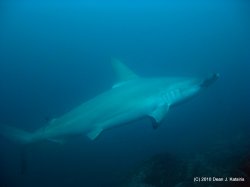
The Gordon’s Rocks dive started a bit rough. The visibility was not too great and aside from some white-tipped reef sharks and a scorpion fish, we didn’t see much. The current was incredible, and we were pulled along the rocks at a fantastic speed, not to mention that there was some pretty impressive surge bobbing us up and down. There were a few beginners on the trip, specifically Nick and Erez, and they were out of air while the Canadian and I hadn’t even used half our tank so we all ascended and boarded the boat. I was pretty disappointed as usually those with air left continue, but the boat took off and dropped us off at a second dive site on the Rocks, which was even better than just letting them ascend without us. We were not down three minutes when the dive master, Alejandro, rapped anxiously on his water tank with a diving knife. There, larger than life (and quite capable of putting an end to any of ours, incidentally) were two Hammerheads emerging from the murky water literally 6 metres behind us. I’m not great at judging sizes but they were large enough to swallow us whole. We watched as they slowed and one continued while the other turned a corner, bringing it within two-three metres of me as it swam past, eyeing us. I wouldn’t have recognized it right away as their distinctive head doesn’t have that hammer shape from the side (it just tapers strangely) but as it started to swim away from us the head became crystal clear.
Hammerheads are sometimes called the garbage cans of the sea because they’ll supposedly eat anything. License plates, humans, and SCUBA divers. However, it is considered mostly safe to dive with them here in the Galapagos because they have an abundance of food that they actually like hence I don’t believe there have been any hammerhead attacks. The other notable thing on this dive was a sea lion hunting a school of fish and around the rocks, which was really something to see. Back on the surface, we were beaming to the others’ dismay and headed out to North Seymour Island determined to see, well, more. On that dive, we saw spotted eagle rays mating, some turtles, huge schools of barracuda, jackfish, and tuna, and another sea lion much closer than last time. It was a lot more tranquil here and the visibility much better than our first site and everybody came up smiling. The diving here was amazing. The final stop was a snorkel which may have been even more exciting than the second dive as I came across a family of sea lions that were very playful – and I had them all to myself as I couldn’t get anybody out to come join in the fun. They would swim up to me as though checking out their reflection in my snorkel mask and then dart away, sometimes spinning around. I would hold my breath and try to swim under the water like them by waving my body which they seemed entertained at, and I used some of the tricks I’d learned in New Zealand like swimming in circles which they loved as much as the dolphins did. I saw the Canadian swim by with his underwater camera and made the tough choice to try to swim over to him and leave my friends and sure enough when we came back they were nowhere to be seen. It was just for me, I guess.
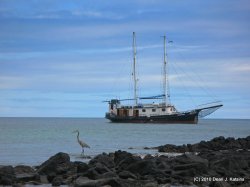
From there we got dropped off on northern Santa Cruz and taxied back to Puerto Ayora. That ended what wound up being one of the best SCUBA trips I have done – ever. I was back in town by three and went to see Bjorn at the hotel; the Canadian guy and Nick came shortly after so I could pay Nick back for breakfast and grab photos from the canuck. Then it was a trip to the bank to extract the last payment for Freddy and our sail trip, a stop at the dive shop to load the dive photos onto my memory stick, and out for dinner. There is a strip of cheap restaurants here that mostly grill meat to serve with... you guessed it, rice and beans (menestra). We met up with the two guys there later – after taking the all-important step of procuring a bottle of rum and 4 L of Coke for our trip – at a Chinese restaurant on that street for some reason. The food was mediocre at best but as a result of a miscommunication, I got to eat extra food Nick had ordered for $4 instead of $6. We went to Nick’s hotel later and sat on their patio with a few more beer and a couple Aussies then went out looking for the canuck and his Ecuadorian friends but came up empty in the latter search. It was getting pretty late and Bjorn and I had to be up early to catch our boat in the morning so we went back and packed, had breakfast the next morning, and for a stark change Freddy was right on time. We loaded in the taxi and took off for the airport where we met our guide and were taken – after running into the kiwis one last time – onboard the Angelique. Our trip to the Galapagos had really begun.
Any trip that starts off with me realizing that I don’t have my camera on me is bound to get mixed reviews. The question was, where was my camera? I had taken it off to put on my shirt at the hotel, but then maybe I took it off again at the ticket agent for the ferry when I transferred all the valuables I didn’t want to bring to the beach back into my day pack. One of the guys that worked at the ferry called the office for me and though it was hard to understand anything in the wind, it appeared they didn’t have it. Could be at the hotel then, or else somebody there made off with it. It figured I’d lose my camera in the safest place in South America. So all the photos you’ll see here are Bjorn’s (though I did take a few of them with his camera and in spite of the automatically pasted copyright watermark). We arrived two hours later though the time passed quickly in my Dramamine-induced sleep. I was not in a pleasant mood in spite of the fact that Miss Isabella was sitting across from me looking quite pretty. True to Freddy’s word, our guide for Isabella was there waiting and brought us (after a dog sniffed our bags) to our respective hotels. The place Freddy said we’d be staying, Sula Sula, was not where we wound up however. We wwere dropped off outside a really dodgy looking place called Flamenco Hostel with a black gravel yard and paint peeling from the buildings; thankfully inside was really nice and so we didn’t worry about it. The family that owns the hotel was also really friendly and lent me their phone to call Freddy, making me a glass of juice at the same time. Freddy promised to check if the hotel had my camera and called back two minutes later confirming that my camera was safe. Then I could smile again.
The guide was back 10 minutes later to take us to a lagoon of flamingos. I was expecting some detailed description of how the flamingos get their colour from eating shrimp or maybe something about how they act as part of the ecosystem, filtering microbes and such. Instead, we went to the lagoon and looked out at three flamingos (it is sometimes full of hundreds more, or so I’ve heard) with a short break for pictures before he took us to the beach for sunset and to talk a little about land iguanas and the volcanic history of the Galapagos which was a bit more like it. The sunset was really pretty, the iguanas were everywhere, and we went later to a platform and watched the crabs scurrying across the rocks. Dinner was at 7 with the rest of our group, which mostly consisted of a loud Italian guy who was friendly enough even if he did basically exclude us by speaking Italian to the rest of the table, some of whom were also Italian and others who could piece it together with their Spanish. There were three kiwis that we had flown in with who also left with us, a few people from Spain, and the Italian’s goth girlfriend from Poland. Over the next few days they would increasingly get on my nerves, insisting that someone ELSE take the single seat up in the truck so they could be together every minute (nevermind that they separated a different couple to do so), making us wait again and again, and so on. Ah well, that’s travel.
The next morning’s trip was a walk up to the top of a volcano whereupon we’d get on some horses and ride around the crater rim. The walk up was a walk that could have been anywhere aside from the fact that the odd vegetation mix marked it as the Galapagos. Our guide put his phone on speaker mode and played some music the whole way up and so I took a rather antisocial position in the midpoint of the gap between him and two other Ecuadorian guys and the loud Italian, trying my best for a quieter walk and to hear the birds and other animals. Maybe I was still grumpy about my camera. At the top, we got on our horses and rode in a mix of galloping, trotting, and walking, though they were quite lazy horses. The crater was huge and impressive and covered in black rock with a few channels carved out of it from the last eruption. It was cloudy and overcast but we could see down and when we walked a little further down to get a better view of the island we were lucky to find the cloud lifted enough to get a great view of the chain of volcanoes that made up Isabella island. From there, it was back on the horses which we rode most of the way down though it was muddy and treacherous at times. My foot fracture from that terrible volcano in Panama somehow made itself reknown and the walk down after the horse wasn’t pleasant at all. But we got down without mishap, loaded up, and headed for the next stop on our tour: snorkelling.
I was pretty excited for the snorkelling but didn’t have much luck when I got in the water. There were Galapagos penguins around but one never swam close enough for me to see it. That would’ve been pretty awesome but it was nonetheless cool to see penguins at all here on the equator. The visibility just wasn’t that great but I don’t want to seem too negative because I enjoyed it even if it didn’t live up to “the Galapagos” standard. We moved to a different site after that which was much cooler – an old lava chasm in the volcanic rock that you could swim along. There, I saw a puffer fish, came eye-to-eye with a huge crab when I surfaced, and had a great time over all. Back on the boat it was time to head for shore, another dinner with menestra (rice, beans), a visit with the kiwis over some beer, and finally an early sleep. The ferry back to Santa Cruz leaves at 6 AM – with a $5 departure tax, by the way – and that meant we needed to get some rest to be at the dock in time. The next few days (Saturday and Sunday) were for Santa Cruz and would hopefully involve me finding a company to SCUBA dive with before setting out Monday morning for our 8-day sail around the islands.
Our very last minute flight to the Galapagos didn’t take long at all to get there though it was delayed somewhat in departure. The South American coast slipped away and before we knew it several of the islands were materializing below. They are (rightfully) pretty strict about what gets on these islands and so we’d had our bags inspected and organically scanned and they sprayed the plane down with something that can’t be healthy before landing. We had already paid the park fee of $100 and the $10 visa pass to enter and on landing everything was rechecked. They’re also pretty picky about who is on the islands which makes it very unique once you get to the main town in Santa Cruz. It’s a cleaner and safer Ecuador. While we were waiting for our baggage at the airport, a chubby man named Freddy mentioned that he might have a boat for us on Monday which he could couple with a two-day trip to Isabella Island. So it didn’t take long before Bjorn and I were on the hunt for deals and comparison shopping. But that would all wait for our crossing some very strange landscapes with black volcanic rock, desert cacti, and plenty of green and verdant plant life all mixed together. The airport is on a small island all its own and so getting to the small town required a bus, ferry, and then a free ride from Freddy. Then, at last, we could truly claim to be here.
When we arrived in the town Puerto Ayora on Santa Cruz, I have to admit I was surprised. The town appeared to be much more developed than I was expecting. I will say now to other backpackers: if you’re thinking about coming here but worried about finding a boat, don’t be. Even if you don’t find a cruise, there are so many places to explore on your own, there are plenty of amenities, and aside from slightly pricier rooms (~$15/person) relative to the rest of Ecuador, food costs aren’t much more than, say, Montanita. We arrived in taxi courtesy of Freddy, and managed to get ourselves a room at the Castro (private bath, hot water, a/c) for $15/night partly because he was hoping to sell us a boat cruise. If we booked the cruise with him, the hotel was free on top of that, so staying was a no-brainer. We walked the town immediately looking for other cruises, deals, and spent the whole evening getting information, comparing, and bargaining until we made ourselves a deal that beat Freddy by $230 although she couldn’t confirm our spot so we agreed to make it official in the morning if nothing changed. Back at the hotel, we told Freddy the bad news – he said it was impossible for her to offer that price but if she had then we should take it and we thanked him and said goodbye. Thirty minutes later he was back knocking at our door saying he’d gotten off the phone and managed to get her price AND shave $20 more off of it – not to mention throwing in our first hotel night for free. So, he took us out to have a firsthand look at the boat, meet a few of the passengers who seemed happy if seasick with their choice, and we made a new deal.
The cost wasn’t cheap – nothing in the Galapagos is – but for 8 days on the Angelique, a Tourist-Superior sailboat with a/c and hot water with all food, activities, and snorkelling equipment included, a two night stay on Isla Isabella including a volcano climb with horseback riding, a visit to a flamingo pond, snorkelling, and return ferry, and our first night’s accommodations free cost us $1130 all in. Considering that most last minute passengers were paying $1200 for just the boat (and those that booked ahead were at nearly $2000 if propaganda is to be believed), we thought we did pretty well for an evening’s work. To celebrate, Bjorn and I had a drink and cheered, for the first time, to Cotopaxi AND The Galapagos. It was Wednesday night, April 7 and we had woke up that morning in Montanita with no idea we’d be in Galapagos and with a successfully negotiated cruise by that evening; that said the timing was a bit tricky. SCUBA trips leave at 7:30 AM and our boat left Monday morning from near the airport (Freddy was taking us out there). That gave me Thursday-Sunday to get in a dive, but we also had two nights/three days occupied with the trip to Isabella Island. And I couldn’t SCUBA Thursday as I had just flown and you need at least 24 hours, so that meant the next day we were headed out to Isabella at 2 PM.
That morning, however, was ours and we planned to go check out Tortuga Bay... that is, after paying Freddy a deposit. Nobody here seems to accept credit cards in spite of the large amounts of money changing hands and so most agencies are pretty happy to accept payments in doses. Most bank cards have daily limits, after all, not to mention some ATM machines. Freddy wanted the whole thing now but finally we convinced him to take as big a down payment as we could muster and quickly so that we could still get to Tortuga Bay. We didn’t have a lot of time but we did manage to make the 45 minute walk out and were not disappointed. Miles of white and pristine beach await with scarcely a soul to be found – in fact, wildlife outnumbered people by a fair margin which is just the way it should be here in the Galapagos. The surf was definitely up but you could walk a distance further to get to a tranquil spot where there were virtually no waves. Just iguanas, pelicans, and you. It was here that I saw just how magical this place was, that these creatures – some of which know planet earth only as a single island in this archipelago – had no fear and in fact even curiosity for humanity. We also ran into Dylan and Connor of Cotopaxi fame on the beach and chatted with them a bit about their stay in the Galapagos after which they treated us to some warm but tasty Scotch and we said our goodbyes. There would be several returns to Santa Cruz island, including our final stop from the boat on a distant Monday to return to South America, but we hurried back along the path just in time to catch our two-hour ferry ride to Isla Isabella.
Bjorn and I arrived in Riobamba mid-afternoon on Good Friday having narrowly escaped the throngs of people in Baños for Easter weekend. That said, I was a little concerned that I had missed out on a pretty unique cultural experience by leaving at the beginning of the festivities. Equador is, after all, one of the most religious countries in the world. Still, we found a really cheap hotel that the Lonely Planet describes as “in desperate need of a facelift” for $4 and found that, for a change, the authors were spot on. It could be a really cool character hostel, Ñuca Huasi, but it looks like the owners have decided to wait for it to be condemned instead. Still, you can’t complain for that price and the location was great or would have been, were anything open. We had learned before coming that the main tourist attraction, the train down the Devil’s Nose whose main feature is that you ride on the roof, was closed for maintenance until August (sorry, Grandpa), so our plan was to try to find a decently priced mountain bike excursion down the slopes of Chimborazo, the highest point from the centre of the Earth. After walking and walking in the rain, we could find nothing whatsoever open aside from internet cafes and a few pharmacies, so we amended the plan yet again to try to find someone to take us first thing in the morning Saturday. Then the hunt was on to find food... we grabbed some fruits at a local market for breakfast and I eventually spotted a few Chinese lanterns and we headed for those. Sure enough, it was open. The Chinese never rest.
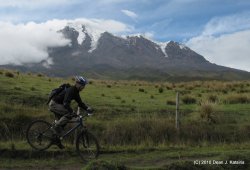
Back in our room later that evening, a low din eventually became full out singing just outside our window. An Easter procession was passing by on the street below. We grabbed our cameras and ran down, following the procession as it passed various platforms where people re-enacted scenes from the crucifixion. Life in the town was resurrected briefly before falling back abruptly to still silence. There was little to do but grab a box of wine and have a few drinks back in the room. The next morning, after a couple hard boiled eggs (it was Easter after all) we were up and at the office of a company called Probici right at 9 AM. It’s an interesting office, tucked into the second floor of a textile factory, but in this case appearances were deceiving and the owner, Galo, was a consummate professional and took great care of us. We managed to organize a trip for 11:00 up to the lower refuge of Chimbarazo (4800m) with a couple pretty nice “old” mountain bikes that were in prime condition, down its slopes and into an indigenous valley where Incans still tend their livestock, smoke out rabbits, and carry on their traditions. Galo would follow us and/or meet up with us at various waypoints and where it was impossible for him to watch from the support vehicle he would supply us with two-way radios so we’d always be able to reach him.
We grabbed a quick breakfast and sandwich, a few snacks, and ran smack into another parade that morning – this time for the rodeo. Horse upon horse and float upon float went by our hotel as we wondered how Galo was going to pick us up in the pandemonium. Then a woman with a two-way arrived and walked us to where Galo, his truck, and our bikes were stuck in traffic. The man had a plan for everything. As we drove towards where Chimbarazo was supposed to be – it was shrouded in cloud that morning – he narrated the history of the area in what would have been excruciating detail were it not for his obvious love of his home. Soon, we were at the park entrance where we managed to get student rates for entry and then we were in the clouds at the refuge. The mountain was very busy for the holidays in spite of the weather and we asked a few Ecuadorians if they had climbed up to the second refuge, giving me the opportunity to practice my past tense. They had and there was nothing more to see but cloud so we skipped that outing, hopped on our bikes and started down. I won’t narrate the entire ride but we started out on the dirt road down towards the park gate and when we arrived there we took off along a dirt trail crossing ravines and other obstacles. We were clad in helmets, gloves, knee pads and elbow pads and I felt pretty safe considering the debacle the last time I was on a bike in Ometepe.
One of the items on the waiver we signed is dog bites, for which Galo takes no responsibility. We laughed about this at first but soon we reached a place where a few indigenous families were burning grass in hopes of smoking out some rabbits for dinner. Their dogs came right up to me quite peacefully and stood at my side but when Bjorn came down the mountain they were chasing at his heels. There were several encounters like this including one in which our roles were reversed and it was only my extreme speed down some of the hills that kept the dogs from catching up with me. Or so I like to believe. The weather improved throughout the day and to our good fortune we soon had clear views of Chimbarazo looming behind and beside us. The sunlight did wonders for the countryside as well, lighting up the canyons and green hills and eventually distant peaks around Riobamba in the distance too. I have to admit that we have been really blessed with great weather from Cotopaxi onward. After our 38km ride back down to some small town with a funky modern church Galo picked us up and drove us back to Riobamba. We talked about where we were headed next and here’s an example of how above and beyond Galo went with us – he took us to the bus station and waited outside for us for a very long time while the ticket salesman served anyone but us until even the woman behind us was getting annoyed. Then, with our tickets in hand for Guyaquil the coming Easter Sunday, he drove us back to our hotel, thanked us profusely, and wished us a happy trip. I wish I could send business his way but the fact is with Riobamba’s train out of commission until August, the town is just not on the tourist trail. Still, anyone going through there, I would HIGHLY recommend taking a day for a really fun and beautiful bike ride with Probici.
There wasn’t much left to do in Riobamba. We were back at our hotel for 6:00, making our outing a 7 hour one, and we grabbed dinner, walked around a bit, and called it a night ... after I finished my box of wine, that is. A $1 taxi to the bus terminal later, we were on our bus for Guyaquil. But it being Sunday – and Easter Sunday at that – we realized en route that there was not going to be much chance of booking anything for the Galapagos that day or for Monday and then we came up with a pretty inspired plan B. After our 5 hour bus to Guyaquil, we grabbed lunch and got on another bus for a small coastal town called Montañita. We arrived there three hours later, marking the first time I’ve been on the coast since arriving in South America. The town is great if a little pricey by Ecuadorian standards, full of life and with a nice strand of beach and a pretty steady amount of surf. In the days, restaurants and beach cafes are the main pastimes where in the evening, a whole street full of little bar stalls called cocktail alley comes alive with music, mojitos, and mixed drinks.
Had I not already spent more than twice the expected amount of time in Ecuador – and that’s not including Galapagos – Montanita is the sort of town I could hang out for some time. Cocktail alley and beach parties by night, surf, sun, and sandals by day. All I’d need was a good book and a hammock. The hostel we stayed at had the hammock, but the book was somewhat lacking. I won’t say it was a bad book, but The Other Hand definitely required turning the other cheek for the first several pages. Seriously, it takes about that long for the narrator to finish talking about what magic “a pound coin” can do in flowery, exaggerated prose. Yet with all that, she never mentions the one thing I’d just discovered it could do: induce nausea. Still, braving through that it turned out to be a believable and even difficult to put down tale of a refugee and an English woman’s twisted destinies. So that took some time, hanging out with some people from Botswana took some more, and the beach and sun ate the rest leaving me red when we left three days later. The plan now was to head to Guyaquil and try to suss out some Galapagos deals but when we arrived at 1:30 and swung by the airport we quickly discovered ourselves fast tracked for a 3:00 PM flight. Galapagos, here we come!
I spent a day recovering from the climb to Cotopaxi’s summit at the Secret Garden and then set off the next morning at 11 for Baños. With me was Bjorn, an Icelandic guy that had also done the trek. The Secret Garden shuttle dropped us off at Machachi and from there we waited on the Pan American highway for a bus heading south and rode to Ambato where we taxied to the other terminal and continued on to Baños. We had been recommended a hostel called Plantas y Blancas (lit: Plants and Whites) and found it a short several blocks from the bus station. The dorms were decent and definitely spotless. Upstairs, a terrace with a breakfast cafe, $1 beers, and games from backgammon to awari awaited. Downstairs, for those so inclined, were steam baths and other spa-related amenities. Of course, having just arrived, we stowed our stuff (lockers would be welcome here) and looked around outside the hostel. The first thing you’ll see when you walk the streets of Baños are row upon row of buggies, quads, and small jeeps for rent. Next are the men whipping toffee by hand in doorframes of candy stores. Travel agencies are lined with photo mosaics of everything from Cotopaxi/Chimborazo to Amazonians in loin cloths and unlucky travellers caught squatting in the wilderness. Navigation is never difficult as the town is flanked by tall mountains with a waterfall on the eastern side and a virgin blessing the town from the hills over the west. Despite its tacky tourist charms, I had a feeling I was going to like it here.
Aside from $1 beer on the patio, the first thing Bjorn and I decided to do was rent a buggy for a few hours to explore the numerous waterfalls on the road west of Baños. Everybody here says you only need three or four hours – but that’s if you don’t want to get off and actually do a bit of walking to see the actual waterfalls. Not knowing this, we negotiated a pretty good rate for three hours of $20 but as soon as we hit the road in our buggy it became apparent that 3 wouldn’t cut it. In the end we paid $7/hr for 5 hours which was still pretty decent. We didn’t plan it but somehow each waterfall we visited grew in impressiveness. The first stop was a double-fall with a really fast cable car to the bottom. From what I’ve heard, this was more of a rush than the white water rafting here. You can also opt to take a different cable car which actually takes you our directly above the waterfalls and stops there to give you a dizzying view straight down. We also passed an old bridge with swing jumping – which is to say bungee jumping except you swing out into a ravine after a bit of freefall instead of falling to the bottom and bouncing back up. We put that on the todo list for our return and motored on. The route takes you on small paths outside the network of tunnels on the main highway so you can see how beautiful the area really is and Bjorn and I took turns driving the buggy up towards the final waterfall of Machaya.
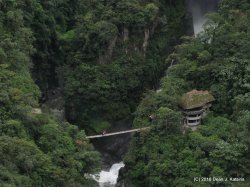
Machaya was beautiful – a really spectacular waterfall from great heights into a valley far below. We walked down to the bottom in a light drizzle only to arrive in pouring rain which only served to fuel the waterfall further. At the bottom there were “Jacuzzi” tubs set along the riverbank, an unused and dull looking ‘canopy’ tour, and yet more views of majestic Machaya. Then we basically ran back up to the top in a record-setting 10 minutes and tried to dry off in a small cafe. We had saved Pailon del Diablo, a very impressive looking beast, for last but now it was raining really hard. We shrugged it off and set out in our buggy once more, finding that the rain abated as we approached the Pailon. Again we descended, crossing a high suspension bridge and finding ourselves face to face with the most impressive waterfall yet. It had carved a pillar of rock out of the cliff face and bounced like a pinball between the cliff and the rock pillar. There was a staircase up for closer looks at the waterfall and beyond that you could crawl up a small cave to emerge literally at a viewpoint near the very top of the fall from which you could reach out and touch the water roaring past you. A few more stairs and the waterfall was over top of you and all you could see was a blanket of white. In the end, the day exploring the countryside around Baños turned out to be one of adventure and Bjorn and I were happy we’d opted to do this.
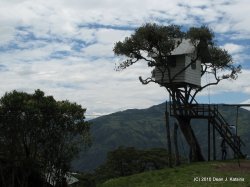
However, we were chilled to the bone but in a town called Baños this is easily remedied. At 6:00 we headed to the hot springs with our kiwi roommate, Berin, and an English girl named Sarah. After alternating between really hot and really cold water several times we felt brand new and invigorated. We also met some people who’d heard of us from the Secret Garden in Cotopaxi and whatsmore were traveling with two Saskatonians named Rich and CJ. I met them the next morning after introducing Bjorn and Berin to three-player pool and cutthroat and also a rousing game of foosball with the owner of one of the bars who really did love her foosball. She practically had a holster for the WD-40 she carried around and her team never lost. Anyway, the Saskatonians seemed pretty cool though I didn’t get to spend much time with them. After meeting them and having one of the delicious if slightly pricey Plantas y Blancos breakfasts (mmm, double pancakes) Bjorn and I set out on a hike into the mountains standing above Baños. That is, after we were accosted by what I’m pretty sure were fake “immigration officers” demanding to see our passports – which we obviously claimed not to have on us. We made our way up and up and all the way up to the treehouse from which there were commanding views of the nearby volcano, Tungurahua. It was also a good place to have a snack, a drink, and sit watching the clouds slowly clear off the peak. From there we made our way back down, past a lady who was very upset I’d taken a photo of her home (nobody visible in the photo) to the virgin and finally back to town. The whole trek was about 6 hours and tiring but worthwhile.
Though we regularly breakfasted at the hostel, lunches were either sandwiches or else taken from the market building which had really nice set lunches for practically nothing. We were the only tourists eating in the place when we went, which is pretty impressive for a town with as many tourists as Baños. And if we thought it was bad earlier in the week, the last night was the beginning of Easter and was downright nuts. The streets were lined with people in sleeping bags waiting for church at 6 AM. We went out for one last night on the town with a sort of quirky American guy named Scott and also met a few American girls. Finally, Bjorn and I caught a bus out of there to Riobamba the next morning, but not after wandering the town and seeing everybody in all-out party mode. Cuy, or Guinea pig, was roasting everywhere (this is a holiday delicacy) and the candy shops were swarmed. Religious icons were being snatched up by the dozen and the streets were more alive than anywhere I’ve seen since perhaps Asia. But, though I felt funny to be leaving a place at the height of its popularity, we had covered everything I wanted to see there and we had a pretty good plan in mind which was to go to Riobamba, mountain bike the next day down Chimbarazo, and then take the lengendary Devil’s Nose train towards Guyaquil where we’d hopefully catch a flight to the Galapagos islands. So we can hardly be blamed for setting off that morning – and Riobamba would hold its own surprises Easter weekend too.
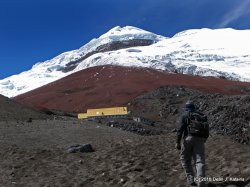
The jeep bounced and plodded up the rocky road as its prey grew larger in the windshield. In the back, four men sat sideways facing each other but none dared allow one eye to stray from their quarry. Cotopaxi. The highest active volcano in the world. 5897m of fire, ice, and boulders thrown like grains of pepper across a dirty tablecloth. There was Bjorn, a 23-year old Icelandic explorer. To him, volcanoes were a fact of life... but he looked nervous now, playing his index finger across his bottom lip. Next to him sat Paul, a Scottish born Englishman who had been living in Quito for the last four months acclimatising and preparing for this day. His face was placid behind a mask of stubble but the clench in his jaw could not be hidden so easily. Dan, another English gentleman sat next to me and coughed nervously. Of all of us, Dan seemed the most uncertain of what lay before us and also the most confident. His friend had climbed it and shown him photos but thanks to the scattering of cloud above he had never looked Cotopaxi eye to eye. For my part, I had spent several days in Quito climbing viewpoints and volcanoes before coming out to the Secret Garden, Cotopaxi to do some higher altitude trekking. I had even climbed to the bottom of the Cotopaxi glacier to assess my chances against such a monster. I’d left confident but was returning tense and uncertain of my wisdom. Finally, the jeep could go no farther and we abandoned it to walk uphill to the refuge.
The trek really began around 1:00 PM. We left the jeep hiding in the shadow of Cotopaxi and, laden with all our gear including food, sleeping bags, crampons, and climbing equipment, we set off for the refuge. One step forward in the loose red sand was matched by Cotopaxi with a half-step push back down the hill. Fully loaded like this it was a slow and ponderous climb to the refuge, hidden over 1 km below the summit at an altitude of 4800m and the battle between the four men and Cotopaxi waged on but was eventually won in favour of humanity. At the top were other foolish mortals attempting the climb. The refuge smelled of hope, fear, and unlaundered long johns. The top of the refuge was at times three levels deep with bunks and I was surprised to find they were almost all full. A group of 20 Ecuadorians – men and women whom had lived here their whole lives – were going to attempt to climb Cotopaxi that night. We claimed four remaining bunks and suited up in our ice climbing gear. Jose, one of our two guides, had made lunch which was delicious and welcome in light of the work hauling everything up here and then Marco, the other guide, took us up to the glacier to work on drills. We strapped our crampons onto our heavy plastic boots and set foot on the glacier. It wasn’t my first time ice climbing as I’d done some previously in New Zealand, but it was entirely different. We learned how to walk up and down on varied terrain and slopes, how to fall, and how to climb. Marco would brook no nonsense with photography as the things he were teaching us might be the difference between life and death but eventually offered to take our cameras if we did well. We did.
After drills and skills we retreated back to the refuge. Jose now had dinner ready and we were ready for it too. The nerves that had shaken us earlier in the day were forgotten now as the task was upon us – the only thoughts were of eating, getting some rest, and getting up at midnight to set out for the summit. By the time dinner was conquered it was about 7:30 and thanks to the altitude I managed to get a healthy three hours of sleeping in. I woke up at 11 PM as the first of the groups began getting up and setting out. Bjorn never slept, I later discovered, as he was nauseous and already in the throes of altitude sickness. With the number of people climbing, the groups had to be staggered and we had somehow drawn the short straw with a late departure. The reason you leave at midnight is not to catch the sunrise at the top but rather because a melting glacier is a dangerous animal. The goal is to get up to the glacier and be off the summit and heading down to the bottom by 7 AM so that you are not unlucky enough to be swallowed by a crevice or buried by an avalanche. Our departure was slated for 1 AM which meant we’d be one of the last on the summit and would have little time for any diversions.
We had our midnight breakfast, specially designed to release energy immediately as well as delayed for our hike when we’d need it most. Chocolate, pork fats, soup, fish, and cheese awaited. Upstairs it was time to don our gear: A thin and thick pair of socks to both insulate the feet and prevent the build up of heat and sweat. A pair of waterproof pants worn over fleece thermals. A long sleeve thermal top with my alpaca wool sweater on top followed by a fleece jacket and then a waterproof and windproof one. Balaclava. And finally two pairs of gloves – a thin inner pair and a puffy and wind resistant outer pair. My inner pair had, like my sweater, been bought in the Otavalo markets but now one glove had inexplicably gone missing. I searched everything there was to search and the only explanation I can come up with is someone had a similar pair and took mine thinking it his. I was left no choice but to commence the climb short a pair of gloves. And this was only the start of the bad luck. We were behind schedule, it was 1:15 AM and we needed to get going. Up and up and up we climbed in the darkness, the way forward lit by a nearly full moon and our LED headlamps. Looking up was a daunting task not only for the energy exerted by the neck muscles but also because you could see streams of headlamps far higher and far further than you.
The walk was beautiful up the red slopes to the bottom of the glacier. The orange lights of Quito could be seen clearly through patches of cloud lit blue-gray in the moonlight. Further off, a thunderstorm flashed, lighting the mountains around the contained it like a witch’s cauldron. The moon was bright and never seemed more near nor clear. But there was little time to enjoy that. I was out of breath and the pace our guides were setting to catch us up to the others was frankly more than I could handle though I did my best. At last we reached the glacier and I stole a quick two minutes to grab a few photos of Quito not to mention the other groups we’d caught up with staging at the glacier’s edge and securing their crampons like Jaws’ dentures to their boots. Here, we broke our foursome into two groups. Marco took Paul and Bjorn and they left first, while Jose stayed behind with Dan, myself, and the terrible crampons I’d been issued. As Marco had reacted earlier, so too did Jose. “These are yours?” he asked me. “Nope, they’re from you guys,” I replied only to hear a muttered “Que mal” under his breath. How terrible indeed. We at last set off on the glacier and wound our way up steep and narrow tracks in the snow and ice. At what is likely the steepest bit of the whole walk the crampon on my left foot skewed itself off my foot. I managed to climb one footed to a nearby flat point and we refastened that crampon then set off on the steep paths again.
The next malfunction was my other foot not many steps further up the glacier. Jose didn’t bother to conceal his thoughts under his breath and re-fastened the left crampon to my foot on the steep slopes while I concentrated on not sliding down to my doom with only half the usual grip. In all honesty, such a slide would not have been my doom, or at least not probably. We all wore harnesses and were roped together so that there was not much space between Jose, who led us, myself, and Dan at the back of the chain. In the event that someone should slide or fall down a slope of crevasse the other two would hopefully have grip enough to arrest the fall and help get the victim back on track. That is, assuming that the harnesses worked better than my crampons were that evening. It was maybe only thirty minutes more when my left crampon completely fell apart. Somewhere a screw that held the expanding joint in the bridge of the foot together had worked itself out and was nowhere to be found. Dan squatted beside me, no doubt annoyed as much as I was and Jose surveyed the damage. Unlike the last times, he was sad this time. He looked up at us and said, “We can’t go to the top. Not with this. I’m sorry guys”. Dan immediately insisted that we WOULD find a way and we weren’t about to miss going to the top. My brain was hard at work trying to find a way to hold this crampon together but in the end it was Dan and his determination that kept us moving uphill. He removed a shoestring he’d used to insulate his cold metal ice axe and managed to wrangle together a solution.
Jose still looked unhappy. “I’m sorry but even if that holds together, we’re probably too far behind now to make it to the top in time.” This is when I discovered the reason we left at night instead of in the morning. We had a 7 AM curfew. Still, I was determined not to be the cause of failure even if it was the crampons I’d been given and we set out at a pace I doubt I could equal were I to attempt the mountain again with months of training. We made 450 metres more in altitude in so short a time that Jose was impressed and we even overtook another group. This was no easy task and I only managed to draw a full breath every one to two minutes. I had to lobby for 10 seconds here and there to attempt to slow my heart and breathe in and was only greeted with Jose saying “Come on, come on, let’s go” in Spanish and Dan’s more friendly encouragements. My crampon disintegrated again at that marker but we didn’t lose the shoe string. We refastened it yet again with the shoestring but none of us had much faith that it would hold. I took off my camera strap and we used it to help pull the crampon together and reinforce the shoestring and it seemed solid. We made a lot more ground but were racing against the clock – it was looking like we’d just make it to the summit in time when the crampon fell apart again.
Everytime this happened, Dan and I both had fearful but determined looks. We had not gone this far, through so much misery, to be thwarted now. I was at the point of leaning heavily on my ice pick and occasionally even having bouts of dizziness when I didn’t get enough air. Even Dan was tripping over his own crampons (though they held together) from time to time. We managed to resecure the crampon and began our slow step-1-2 step-1-2 pattern onward and upward. The moon had set and it had gone dark but eventually the sky began lightening. In our scenario that was a bad sign as we didn’t have a lot of time after dawn to get to the top. But with more trudging, the end was in sight. We were on the very steepest section of the glacier when the crampon, for one last time, fell apart irreparably. What frustration to be within sight of the top and see others already coming down as we sat what appeared to be 20 minutes from the summit unable to ascend or for that matter descend due to a failed crampon. We tried a thicker string and a sewing kit but there was no hope for it. We were beaten at the last by Cotopaxi. Marco came down with Paul and Bjorn, returning from the summit, and took a look at my crampon before deciding it was worthless. Here I have to credit the guides. It was now most unlikely we’d make the summit by 7 AM (a scant ten minutes away) but instead of insisting we turn and walk down Marco gave me his crampon and descended the whole of the glacier effectively on one foot. Jose led us upward, knowing I’m sure that we had no chance of reaching it by 7.
We didn’t reach it by 7. It was not twenty minutes away but almost 45 minutes away. By the end I was so exhausted by false summits and the strain of the night that I was using my hands and arms to support myself on the snowbanks along the path. Paul had ascended the last 50m on hands and knees. We had passed plenty of others who had not made it to the top. There was nothing easy about this. Still we pressed on and at last I saw the sun hitting the top of the last rise in such a way that it had to be the top. Soon... step, 1, 2, step, 1, 2, we were there. There was nothing above us anywhere, just snow at our feet that melted into cloud as though we were standing on top of some white blanket covering the globe. The sheer exhaustion, the feelings of fighting a losing battle, the frustration with the crampon, and the sheer amount of physical and mental exertion all culminated at once and I felt the feeling that gold medal champions must feel after a long hard season of work against all odds. I was shaking and could scarcely hold it together. I made it to the summit against what felt like all odds and almost collapsed into a sobbing heap of wasted flesh; I was completely overwhelmed and everything I was feeling was threatening to bubble out of me. Soon that emotion was replaced by a smile that grew from one ear to the other and wouldn’t disappear for the next several days. The weather was perfect that morning and Jose gave us plenty of time to get photos and enjoy being at the summit as a result. We arrived as the last group of climbers who’d made it were leaving and had it all to ourselves.
The views from the top were out of this world. The smell of sulphur wafted up from the crater yawning below us, ringed in a donut of white snow. Clouds made up most of the landscape but in the distance other high peaks punctured them to make a really top-of-the-world feeling. There were also breaks and the sheer altitude above the valley where Secret Garden lies was staggering. I have never had vertigo on a mountaintop before but this was the very beginnings of that sensation. Finally, it was time to go and we descended as fast as we could. The descent was dangerous but only getting more dangerous as we waited. Jose wouldn’t allow us to stop for photos but I pulled out my camera and tried to take a few photos on the fly as we walked down – that is, when I could spare a hand from my ice axe. It was a tiresome descent on the legs, especially at the speed we were coming down, and eventually he capitulated and we had a short rest. While I was putting something back in Dan’s backpack, I lost my outer glove to a rogue gust of wind which sent it flying into a chasm. So now I had one hand exposed and had to switch the glove to the hand with the ice pick. We crossed several chasms that had already opened in the warm weather and found ourselves at last over the only one big enough that I had noticed it on the way up. It was a lot more terrifying in the light of day. The bottom could not be seen and a small aluminum ladder was laid across it which is no easy task to walk wearing crampons. Dan went first, took one step and fell straight forward onto the snow opposite. Whew. There he took the rope and wrapped it around the ice pick then drove it into the snow. Next it was my turn.
I got to the edge of the ladder and made a mistake. I looked into the blue abyss of the chasm. Jose quickly snapped at me to look forward and not take my time – the ice was melting and time was of the essence. I stepped on to the first rung. I balanced on one foot and tried to find a place to put my second foot that would be solid and not on crampons then found it and set my foot down. Then the next rung and then I was across. I leaned on my ice axe as I manoeuvred my other foot onto the isthmus of ice. That’s when the ice and snow beneath it gave way and I lost my balance as clumps of ice rattled down the chasm to nothingness. I sprawled forward and landed on solid ice then crawled forward quickly to a thicker part away from the edge. Then I remembered to breathe and found myself shaking as I sat beside Dan looking at the chasm. Again, we had ropes, anchors, and so on, but it was a terrifying experience nonetheless. Jose also helped another group across the dangerous chasm and soon we were all smiling again – another challenge overcome. The rest of the way down was uneventful. Steep, hard, and fast, but uneventful. We arrived back at the refuge looking haggard but successful, packed our stuff, and we were heading for Secret Garden Cotopaxi before we knew it. There, all the people who had been there when we set out on our adventure met us with cheers, hugs, and beer. I looked back over my shoulder at Cotopaxi just in time to watch a cloud hide its face from us. It had nothing to be ashamed of, however; had it not been for the weather, a determined guide and a persistent co-climber, it would have beaten any of us standing there. But the day was ours and I wouldn’t stop smiling for a long time to come.