Lake Titicaca is often mistakenly called the highest navigable lake in the world and it’s easy to forgive the boast. At 3809m in elevation and ridiculously huge in size (165 km long, 8560 square kilometres, and 274m deep) such exaggerations are performed by your very senses. Puno, the main stop on the Peru side of the lake, was to be our last stop before crossing the border to Bolivia which shares the lake. We were met at the bus stop by a woman with a hostel for 15 soles which solved the first problem. Dinner, the second, was taken care of by a local who brought us to some of the best roast chicken I’ve had in South America. The third and final problem was what to do. There are two large islands off the coast that you can visit by boat and (on Isla Tequile) stay with a family. Additionally, there are the floating island(s) of Uros which other travellers had warned us were very touristy. Then on the Bolivian side is Isla del Sol which is similar to Isla Tequile. So I devised a pretty good and efficient plan. The next morning we’d head to Uros and visit the floating islands in spite of recommendations against it – it’s pretty unique and I would do my best not to be phased by the overt tourist industry – and then catch the afternoon bus to Copacabana in Bolivia. After a night there we’d walk 17km to the tip of the peninsula and catch a boat to Isla del Sol where we’d hike that afternoon and the next morning before boating back and bussing to La Paz. Sounds good if busy, right?
The Floating Islands
It takes about half an hour on the boat to arrive at the floating islands of Uros. They came about as Aymara people started living on reed boats to avoid the aggressive Inca. As the boats got larger they eventually started fashioning islands upon which they’ve lived for the last few hundred years. Islands vary in size and population but usually house 20 or so people and are run (and anchored) autonomously. We were greeted by waving inhabitants on the shore and the women hastened to tie down our boat. Then our guide and the chief explained how the islands are constructed and anchored and a few of us (myself included) were invited into the chief’s home. We had been told that they don’t actually live on the islands anymore, but that is definitely not true. The chief’s home had four beds and a TV run by solar panel and he told us about how the kids were schooled and other things of note. They too are having a problem with most of the young leaving the ‘farm’ for the cities and a more modern life. Still, they speak Aymara so the language is preserved for this generation at least. Of course they tried to sell us their crafts and then we were brought onto a reed boat and paddled to another island – only to be told at the end that we had to pay for it. Things like this always bother me but I was oddly unperturbed this time and paid what little change I had which wasn’t the full fare anyway. The whole trip was three hours and, contrary to other reports, interesting and worthwhile. We were back in time for a lunch (Alpaca Saltado) and caught the bus to Bolivia.
At the Copacabana
The border crossing was the easiest I have ever done. The guard on the Bolivian side didn’t even look at my identification page, he just flipped to a page with room for a stamp and wrote down 30 days for me. Ty, however, had a big series of headaches involving photocopies, photos, and a $135 VISA processing fee. We arrived in Copacabana that evening and had a trout lasagne that was good if somewhat small. Then a portion of fries and then some beer to try to fill the void. We sat with an American couple from Pennsylvania whom I didn’t realize pronounce ‘full’ as ‘fool’. With nothing to do and the temperature unpleasantly cold, we went to sleep early. The next morning Ty and I set out on the road to Isla del Sol. It’s possible to boat straight from Copacabana but what fun is that? So we walked and saw only one other traveller the whole time, and the walk was beautiful and interesting. The locals we encountered were exceedingly friendly, stopping as we passed to get our life’s story before we said a friendly goodbye. One group of men we said hello to offered us some of their beer after only a brief and friendly conversation. It was 10:30 AM so naturally we accepted. They were hilarious, gregarious, and schooled us on customs of drink. We paid for a few more beer, kicked the ball around with one guy’s son (and another’s grandson) and said our goodbyes. Bolivia had earned a lot of brownie points by the time we met another local, Hilario, who ferried us across to Isla del Sol after stopping to look at some other ruins on a mostly abandoned peninsula.
Island of the Sun
The boat ride out was beautiful if a bit too relaxing and I alternated between a wide-open mouth as I looked at the huge snow-capped mountains on the horizon and a wide-open mouth as I snored and slept in more tranquil parts of the journey. He dropped us at the southern tip of the island and we began our trek to the main town in the centre. As we passed some ruins a man came up from the fields asking for money to enter the island. He had no ID, no uniform, only some paper tickets and since I’d never heard anything about fees to visit the island, I said no. We had an argument and he refused to let us pass and then we saw a group coming out of the ruins. Can we ask them? No, he wouldn’t allow us to do that either. So I stepped around him and asked them anyway and sure enough there was a fee. We paid it and continued on to the town. There was a Bolivian wedding taking place in the square overlooking the water and we watched for a while and marvelled at the band starting and stopping seemingly at random intervals and mid-song as well as the huge collection of people at the wedding and, a bit later, the huge collection of beer. Then we had dinner overlooking the lake and went back to watch the wedding some more over a cheap but pretty decent bottle of Bolivian wine ($3) whereupon we were accosted by a rambunctious little boy climbing all over us who went from funny and cute to annoying and still sort of cute. It was getting stupidly cold and we had no luck meeting anybody so we went back, watched the excellent City of God, and called it a night.
Escape from the Island
The next morning we trekked all the way to the northern tip of the island and the Temple of the Sun which took a solid four hours but allowed us to say that we had walked the entire length of Isla del Sol. The temple was pretty cool but you need a guide to know what you’re looking at besides rooms and windows. Then we turned and took the low trail south to a small northern town from which we were supposed to be able to get a boat back for 20 Bolivianos ($3). Unfortunately, we arrived after a large group of others who had done a terrible job negotiating and got the price for 12 people on a boat to 500. And the boat would only go halfway to the tip of the peninsula instead of Copacabana, meaning we had to additionally get a taxi. Supposedly the waves were too high and it was dangerous but talking to some locals that did not seem to be the case. Still, he refused to take more than 12 on the boat and 13 others (plus us to make 15) had to take a different boat. Naturally, he wanted the same deal but we managed to get away with paying 30 each. Sure enough, the water was fine – he would use the motor to push the boat and then let off so that the wave crests could push and he only used one of the two motors. We got back and surprisingly got our taxi for less than a dollar promptly and soon we were on a bus for La Paz. First there was a channel to cross in which the buses were emptied and put on small floating platforms so that they bobbed in the water like toys in a bathtub. Meanwhile, we crossed on small boats. Otherwise, the journey was uneventful and we reached La Paz, the highest capital city in the world, 5 hours later.
After a somewhat restless sleep on the bus to Arequipa, I was happy to get off the bus and grab a 3 soles taxi to Plaza de Armas in the town centre. If that sounds familiar, it seems that every city in Peru has a Plaza de Armas at its heart. I had arrived at 5:30 AM so as I walked around looking for a cheap hostel the sun was glowing on the mountaintops. Arequipa is surrounded by mountains and volcanoes and the latter became a foundry for white volcanic stone blocks upon which the city was built. Arequipa has a reputation as a beautiful city and certainly it is set beautifully but I didn’t find myself especially awed by its beauty. Maybe I missed the best parts? There were certainly interesting and pretty alleyways leading to church-side courtyards and I admit I didn’t enter the rather pricey monastery but while the city was far from ugly I didn’t love it. Maybe I’m just a victim of high expectations. Our – that is my American friend Ty and I – were here for other reasons anyway, specifically sussing out the nearby Colca Canyon which is said to be one of the world’s deepest.
We arrived separately as our departures from Machu Picchu the day prior had been on entirely different timetables but we’d arranged ahead to meet in Plaza de Armas at 1:00. My morning walk had found me at the corner of Puente Grau and Santa Catalina where I settled in the Santa Catalina hostel for 15 soles per night with a private room. This hostel, it turned out, was right around the corner from where Ty’s taxi driver took him. We met for lunch (pretty decent pizza) and had what was basically a lazy day of strolling. I walked the pedestrian strip and passed a market where I saw a painting of Arequipa that I decided to seek out with Mount Misti overlooking an old stone bridge over the river. I had also spent a lot of that morning getting information about going to Colca Canyon and seeing if we could do it on our own. That evening we sat and had a great beer in Plaza de Armas watching the sunset. The next day was a Sunday and Mother’s Day so after a call home Ty and I went for lunch which was a bit of a splurge but HUGE and worth it. On the platter, for $7 each, were two chicken breasts, sausage, beef, pork chops, sliced beef hearts (better than liver but the only thing left), bottomless fries, a salad buffet, and a beer. After all the trekking and small menu/hiking meals, I somehow managed to finish my share aside from the beef heart. At one point a little girl walked in with her family and seeing two foreigners said to us, "Ella es mi amigita!" (this is my little friend). Meanwhile, some drama was unfolding in Ty’s hostel with a woman and her drunk/possibly abusive English (or Australian – Ty wasn’t sure) boyfriend/co-parent.
Somewhat recuperated, we set out the next morning at 11:30 for Chivay (there are earlier busses all the way to Cabanacolpe but all were booked) and our third trek in less than two weeks. Once again, we had decided to travel it solo and make our way with less hand-holding and money-handing. The bus to Chivay took a long time to get there but was uneventful. The local bus from Chivay to Cabanacolpe left about 45 minutes after we arrived and was more interesting. I was impressed to see an orderly line formed waiting for the bus and then a little less impressed when four traditionally dressed women who’d been sitting walked right to the front and then simply amused as the line devolved into a mob around the bus full of elbows, shoving, and the usual bustle. One man pushed me right into the door and I used it to push back and knock him right out of the circle before getting on board. There was no chance of a seat and not long after we were aboard there was no room left to stand either. We set out and I realized with horror and too late that I was standing right next to the speaker. Which, as it inevitably does, pumped out terrible Peruvian music at a level that warned passing vehicles of our approach. My earplug-headphones saved the day – that and that I had the good fortune to be standing right in front of the first passenger to get out of his seat and disembark. I offered it first to the lady behind me who refused twice and then sat down happily.
We arrived near sunset at Cabanacolpe atop the canyon and stayed the night there at a hsotel in, you guessed it, Plaza de Armas for 7 soles each. Dinner was another 5 soles as was breakfast the next morning. We set out around 9 AM towards Llahuar on the road less travelled down into the canyon. The walk was stunning and full of colour – red gorges look like angry wounds in the mountainside which is alternatively yellow, white, and golden. Cacti, rock, dust, and dry air all vie for whatever moisture you’re willing to emit. Aside from being a beautiful section of the canyon which, really, is not a risk wherever you choose to walk here, there were two advantages to our route. The first was that it was all ours. For seven hours we walked and passed only a single woman and her three mules. And a dog that followed us from the very start all the way down the trail who we named Guia (Spanish for guide). The second was that this path was so little used that it was not necessary to pay the 35 soles park fee so long as you crossed the bridge below near San Galle instead of San Juan. Our plan had been to walk to Llahuar which should have taken about 5 hours but we arrived there in 3.5 and that meant it was only 12:30. Llahuar, it turned out, was just somebody’s home and looked desserted from our viewpoint in nearby Paclla so we decided to do something all the guides had told us was impossible and make it to San Galle that same day. We didn’t quite have enough food (one mandarin and several mini-muffins each) but our water situation – much more important – was adequate. We ate a bit, gave Guia some water he looked desperate for and a few crumbs and set off.
The trail to San Galle was indeed tiring and I was exhausted by the time we completed an hour and a half climb which I feared was at the very least unnecessary. We had ascended to the opposite side of the canyon, however, and the views were spectacular from here as well. We ate the remainder of our food and set off downhill. Eventually, we spied San Galle below and, true to the map, there were palm trees and pools; it was a literal oasis in the desert canyon. We got there a bit after 4 and settled in the OK Paradise/El Cielo hostel by 4:30 making the total day a 7.5 hour journey which is far from impossible (although we had the benefit of a cooler and cloudy day). Our hostel, which only cost 5 soles each, had a swimming pool and though it was getting cool I went for a swim anyway. It felt great to get the dust off my face. We thought there were hotsprings here but it turns out they’re just warm springs at about 28 degrees which everybody uses to fill their pools. Guia had abandoned us when we hit town but we were joined a bit later by two cool Israeli guys and two young Dutch cousins and then for dinner as well by two Danish girls. They were all pretty friendly and we had a nice dinner together for 6 soles. Breakfast was at 7 AM the next morning and was 5 soles but both Ty and I were really hungry still. The climb out of the canyon was surprisingly enjoyable and we surfaced at the top about 2.5 hours later. Priority one: bus ticket back to Arequipa (15 soles). Number two: food! The bus left at 11:20 AM with us and two decent-sized lasagnas in our bellies (plus some granadilla and chocolate for dessert). While we waited for the bus, Guia appeared out of nowhere to say goodbye. That was a nice touch.
The bus ride back to Arequipa was stunning and afforded incredible views of the canyon all along the way. I even managed to whip together a panoramic photo as the bus drove! I guess we were too busy being jostled on the way there to notice much. Back in Arequipa – after an ‘alpaca’ sandwich that I’m pretty sure by both look and taste was turkey in Chivay – we got our bus tickets for the next day to Puno on Lake Titicaca near the Bolivian border, went for a decent dinner at a nearby restaurant and went out for a couple beer and pool in a four-storey multi-themed bar. I had a streak of good luck and I think the final score was 5-1 for me. The nightlife here is supposed to be pretty good but there was none to be found on a Wednesday night. The bar wanted to charge us for playing pool (the price of two over-priced beers there) but they had neither told us, put up a sign, or given any indication whatsoever that this was the case. We paid half after arguing and discussing and left. The next stop is the last in Peru and I am, as always, excited to be getting close to yet another border and new food, drink, culture, and experiences. Incidentally, our cost for Colca Canyon: 61 soles. Tour cost: 130 soles.
There are four main ways to get to Machu Picchu from the Inca capital of Cuzco. The first is the world-famous Inca Trail which winds its way past several other Inca ruins over the course of five days, arriving into Machu Picchu through the sun gate at dawn on the fifth day. It is expensive, booked months in advance, and probably worth the hassle and expense but I wouldn’t know. The Inca trail and Machu Picchu had been closed for several months due to flooding which had cost a lot of pre-booked people to lose their money and it was all speculation as to the date things would be reopened. The rest are ‘alternative’ treks that don’t have the severe limiting of the Inca trail. We considered the Salkantay trek which takes you five days through the mountains to Aguas Calientes but we had just done a four-day trek in the mountains of Huaraz. That left the Jungle Trek as an option, which starts with a downhill bike ride and spends three days walking to Aguas. But the more we researched (and here I have to give Virgilio credit because he did almost all the legwork) the more we discovered that we could do the same route as the Jungle Trek on our own for $50 less and in one day instead of three. With some reluctance we embarked on that path at 7 AM.
Our taxi driver didn’t know exactly where the bus station was to Santa Maria, our first stop in a day of travel to Aguas but we managed to get there in time to get our 7:30 bus (20 soles). And then sit on it and wait 40 minutes for it to leave. The bus was so slow and behind schedule that even the locals, who must surely be used to Peru-time and the lateness of everything, were starting to yell at the bus driver. A bus that should have taken 4-5 hours took 7, bringing us into Santa Maria at around 2:00. We passed what would have been our Jungle Trek group on the bus, biking along the roads and making their way down. From Santa Maria we rather quickly caught a collectivo where Ty and I had to take turns putting a shoulder out to fit in the back for 10 soles and about 2 hours to Santa Theresa. We passed the Jungle Trekker on their second day walking along the road since the trail had been washed out and looking miserable. The road was dusty and full of sharp rocks not to mention waterfalls to ford and I began to worry about the tires. Sure enough, we picked up a flat which, to look at the bright side, gave us a chance to stretch shoulders and legs. It also allowed us to discover that our current tire only had three bolts and watch in horror as our driver snapped off a second bolt leaving only two on the same side remaining.
The flat tire lost us about 15-20 minutes and the spare was at best wishful thinking but it made the last three kilometres or so to Santa Theresa with us. From there we were quickly herded onto another collectivo, late as we were, to try to catch the last train into Aguas. This one cost us 4 soles more and took us about 15 minutes to get to the end of the road – a road that used to run all the way but had collapsed into the river. The solution was to scramble down towards the river and jump in a basket (1 sole each) that cable-crosses the water. We were at the other side about 4:15 and the last train to Aguas left from a point 30 minutes away at 4:30-4:45. We literally ran up the hill, running so hard with backpacks that my side would be sore for days, and in spite of it all, arrived at the small tent-town after ten hours of traveling ten minutes too late. The only option now was to walk along the train tracks two more hours to Aguas and so that’s what we did after a short regroup. We crossed a bridge precariously hopping railroad ties and getting about halfway before I discovered a walkway on one side of it. It got dark and the headlamps went on and we arrived finally in Aguas at about 8 PM, hungry and tired. The first thing we did was bought our 126 soles admission into Machu Picchu for the next morning then went to Hostal Mirador (20 soles/night), grabbed a cheap dinner we were almost too tired to eat for 10 soles more, and went to sleep.
We come now to what is often the highlight of a trip to South America: the day we visited Machu Picchu. It came early; I woke up at 3:45 AM and got the others up. We were out the door and walking in the darkness by 4:10 AM, making our way back down the river to the bridge crossing for Machu Picchu. There were a surprising number of people that had already started and I couldn’t help but wonder how many more were still ahead as we passed group after group. There are 400 spots available to climb Huaya Picchu, a neighbouring peak with views down at Machu Picchu; 200 at 7 AM and 200 at 10 AM. I did have to stop for a break twice as I couldn’t keep up Virgilio’s pace but aside from Ty (who had fallen behind to have a snack) nobody passed me. Soon there appeared to be light and after maybe a couple thousand stairs I arrived at a hotel where a handful of people seemed to be taking a break on a bench and applauded as I burst from the trees. I took two deep breaths, scanning the faces in the darkness to see if Virgilio and Ty were waiting then asked which way the trail went from there. It was then that they waved at me from their seats and announced we were at the top. It took me about 45 minutes to do the two hour climb and Virgilio and Ty perhaps 40. In spite or perhaps as a result of all the people we’d passed on the trail, we were 12th in line to enter Machu Picchu and about an hour early.
They passed out tickets for the 7 AM or 10 AM climb and we of course had our choice. A local recommended the 10:00 because of the heavy cloud cover and I accepted his expert advice (although I liked the idea of getting some scattering cloud in my photos from above, it wasn’t worth the risk) and at 6 AM we entered. The whole of the ruins were covered in a heavy white blanket but the sun was up there somewhere and within minutes patches of clarity began to momentarily unveil parts of Machu Picchu as the three of us rushed to find some nice photos with nobody in them before the hundreds of people that had lined up behind us (some took busses, others walked later or slower) began flooding the site. It never ended up feeling too crowded aside from a few choice places but I digress. If you are ever to visit this magical place (and you really must) then there is nothing better that I have seen than Machu Picchu in the morning. To try to put into words the feeling as bits of clear sky reveal the incredible mountains above, below, and all around the ruins and strands of fog wisp across parts of the ruins hiding this and exposing that as though you were watching the very earth perform an ancient dance of seduction is simply not possible. To try to photograph Machu Picchu is madness. I am, it seems, quite mad.
After wandering around the ruins on our own for a couple hours, we went back to the entrance and managed to negotiate a guide for 60 soles (20 each) in Spanish as it was cheaper that way and our “Spanish” guide seemed to have English the equal of the more expensive “English” guides anyway. Plus we had Virgilio to translate if anything got really confusing. His name was Juan and he was great, leading us up to the famous viewpoint from the Warden’s House, into the Temple of the Condor (and the Condor’s stomach), around the ancient aqueduct system, and all the way to the other side of the ruins. He explained the Inca solar calendar (damaged irreparably during the filming of a beer commercial some years back), the importance of 3, the compass with points to true and magnetic north, the alignment of windows, rocks, and other elements to correspond with the stars, solstices, zeniths, equinoxes, more. Then we set off to the top of Huayan Picchu, or at least I did while Ty and Virgilio took a lunch break. I wanted to get up as soon as possible while the sun was still in a decent position for photos.
Again I made it up in good time though Ty and Virgilio weren’t that far behind all things considered. We sat there looking down at Machu Picchu and I felt that we were too high to really have a great view or photos from above but we took lots anyway and I wound up taking photos for a bunch of other people somehow. I had my lunch while we sat at the top and chatted with two beautiful Mexican sisters (Porque tu hablas mal, Dean?) and then we started back down. The three of us went up the smaller peak and Ty shared some of his remaining water with Virgilio and I, who had run out and were parched in the midday sun. It had been a long two days and we were tired but we did a walk out to the Inca Bridge which wasn’t worth it for the bridge itself but was incredible as you can still see the old trail that wound VERY precariously along the cliff of the surrounding mountains. We were going to take a bus back down from the ruins but instead of 7 soles it was $7 so we walked (after I spent far too much on an ice drink to help my huge thirst) back down the way we’d come up and were back in town 10 hours after setting out that morning, at about 2 PM. After lunch and a well-earned beer I went to check on train tickets while Ty and Virgilio went on the internet and bought myself a ticket out for $34 the next morning. It was that or go back the long way we’d come and probably take two days doing so. Or so I thought.
Virgilio had meanwhile discovered another route that allows you to walk along other train tracks to Ollontaytambo where you catch a bus back to Cuzco for 7-10 soles. It was a 28km walk but it was free and he and Ty took decided to set out at 5:30 AM the next morning on that path while I had already committed to the train. I didn’t mind too much in spite of the expense as I love trains and I had to get photos for Grandpa anyway. We all went to the hot springs which were disappointingly tepid and filled with obnoxious travellers from a country I won’t name who would sit on the stairs and get annoyed when you tried to get by to come in or exit. The best part was jumping in the cold pool then the ‘hot’ one. Still it helped and did feel good on sore legs and muscles. We were supposed to meet a couple Argentinian girls for dinner but they never did show which was just as well as we were basically falling asleep on our plates. I woke up the next morning to find Ty and Virgilio long gone and enjoyed leisurely getting ready for the 9 AM train. I went down and was surprised to see the rail car had sky windows as well and that I had two seats to myself. The train ride out was great and I just leaned back and watched the scenery rolling by for two hours, occasionally stretching my legs and feeling sorry for Ty and Virgilio on their adventure.
The train can’t get all the way to Cuzco or even Ollontaytambo because of the flooding (they’re working to fix it) so you get to a certain point and then are shepherded into waiting minibuses to get to Ollontaytambo and a bus to Cuzco. I got back to Cuzco and decided that since there were no witnesses I’d grab a burger from McDonalds. I’m always disappointed but it’s so hard to find even decent burgers here that I had been craving it and went anyway. I met up with Ty and Virgilio after that and we totalled up our adventure. The Jungle Trek costs $175 and without the train we had spent $94 ($128 with the train) including meals, admission, guide, hostels, etc. and had a much more adventurous time getting there especially. I know there are people out there who think you’ve cheated if you don’t do some sort of trek into Machu Picchu but unless you’re on the Inca Trail it really is just another walk (and in the case of the Jungle Trek, a pretty poor one mostly along roads) so we were all very happy with our choice and recommend it to other travellers that may undertake this route. We went for a cheap menu meal, said goodbye to Virgilio, and then Ty and I went to the bus station to set off for a night bus to Arequipa and another trek into Colca Canyon. No rest for the weary traveller. Yet.
We had been on the bus for 23 hours on our route from Lima to Cuzco, making it the longest bus ride I had ever been on. We went with a company called Flores (Flowers) and we would never use them again. First of all, they played movies late into the night with the sound cranked so loud that the speakers were crackling and distorting: that is if the movies were in Spanish. If the movie was English, they never bothered to turn the sound beyond a whisper. Not that it mattered, as they had chosen their movies from some archive of Hollywood’s Worst Atrocities. Some Chinese film got played twice, there was an Eddy Murphy as power-executive who’s lost his way, and so many more. A few times the movies looked like they had promise but were substituted within the first half hour. And the movies weren’t even my big gripe. The bathroom became a toxic spill zone, but the worst offense was they didn’t serve me breakfast. Admittedly, Ty (who said he tried to wake me up) could have grabbed mine for me when I woke up, but they should have either given it to me or set it aside. Instead, when I got up to find us stopped at a roadblock (for construction) and asked the hostess for my breakfast she just told me to get back on the bus. Bear in mind this was all in Spanish so there was no misunderstanding. OK, but can you bring my breakfast? Get on! So you’ll bring it eventually? On! She came a couple hours later with coffee and I asked her again for my breakfast. Cafe? No thanks, can I just have my breakfast? A confused look on her face as she asked again, coffee? No coffee, listen. I didn’t have breakfast. I’m hungry and I want my breakfast. No coffee? She asked. Do you speak Spanish? I replied. Yes, of course. Well then I want you to bring e my breakfast that I never had and paid for, OK? Needless to say I never did see her or the breakfast after that.
So I arrived in Cuzco hungry and annoyed in spite of the fact that a sick Ty (almost everybody traveling, it seems) had no appetite for his and gave it to me. Role reversal from the trek, I guess. There was a lady at the bus station with brochures for a decent looking hostel called Machu Picchu and we managed to get it for 15 solas with breakfast which, in Cuzco, is a fantastic deal. We went and checked in and soon Virgilio walked in from his bus and we switched rooms so he could get a good deal too. Cuzco, in addition to being the high-altitude gateway to Machu Picchu (at 3600m) is also a beautiful town in its own right and we walked around and enjoyed the late afternoon sun before the evening cold settled down on the town. We also spent some time that day and the next in travel agents. I already knew I didn’t have a chance of getting on the Inca Trail but I asked around anyway and found one person who thought he might be able to get me on but alas. The Inca Trail is the famous trek that passes many ancient ruins to arrive at the centrepiece, Machu Picchu. There are several alternative treks available, notably a Jungle trek that starts with a huge mountain bike descent on the first day and takes about four days to get there. The second is called Salkantay and takes you high up into the alps. Both end in a town called Aguas Calientes at the base of Machu Picchu and from there you climb up in the morning on the last day to see the site, ruins, and go back. Otherwise, the treks are both ordinary and could be done anywhere.
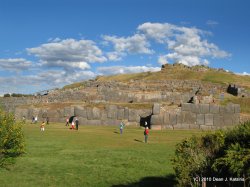
Ty and I gave it some thought and decided that we had just done a big mountain trek in Huaraz and, at least for me, I’d be heading into the Amazon in Bolivia, so there was no need to add on a trek just for the sake of doing so. We discovered also that we could save about $50 making our way to Aguas Calientes on our own with a combination of busses and trekking in a day thus also saving time. So with that agreed on we set out for the Temple of the Moon, a set of ruins above Cuzco. It was a solid hour of walking to get up there and we passed the Saqsaywaman ruins and got a good look at them for free as were didn’t enter but walked on a road that wound around them and then were given permission to cut across by a guard. The Temple of the Moon ruins weren’t very impressive even though we met a guide there who was just hanging around and he generously took us around the site and showed us what had once been and then refused payment. We chatted with him and his girlfriend until just about sunset and then he offered to meet us later and take us to the bus station for tickets to start our DIY Machu Picchu excursion. We met him at 8:00 and he took us up to the station and then we walked back with the two of them.
We were going to all go for dinner but his girlfriend got a phone call that resulted in us being invited to her family’s home for dinner. After making it clear we didn’t want to impose we gratefully accepted this rather unique and generous offer and went to their home. It was an adobe brick home no matter how many times I see them I always wonder how they last so long. Inside was quite a bit larger than it looked and in spite of the gravel foyer had a nice dining room complete with an 18th century painting of Jesus that apparently brings people knocking on their door to pray all the time but especially in March. Dinner was leftovers from her mom’s birthday the night before and included a mix of cheese, river weed, cuy (guinea pig), chicken, sausage, and some sort of fried dough with greens in it. I didn’t opt for more cuy but otherwise it was all good. And that was just the starter. Then they brought us out beef stefado and ram with rice. Finally, it was mate (a shared tea) with orange cake for dessert. We have been really fortunate to meet such great people here in Peru so far and obviously we were all both floored and extremely grateful for their hospitality. We said goodnight to them and went back to the hostel to pack and get ready to set out in the morning on our next adventure: Machu Picchu.
The bus station in Huaraz was like a trekking reunion: Ty and I had booked our bus independently but there now were Cristina, Virgilio, and the Israelis all heading to Lima on the 10:30 CIAL overnighter. We arrived in the Peruvian beachfront capital at 7:30 the next morning and split a cab with Virgilio and Cristina to a place she knew was 15 solas including breakfast: a bargain in pricey Lima. We got there and instead it was 22 solas without breakfast and after some negotiating but the place had something I was willing to pay a lot more for: a fully-tuned upright piano. In all my years of traveling I have stayed in more hostels than I can count and this is only the third to have a piano in it. Moreover, it is the first to have one that is in tune. Sure, when we got upstairs to our room the bathroom floor was covered in soggy toilet paper, a pool of water, and a cigarette butt, but there was a piano! Sure it was mostly Israelis who, when they travel in packs want nothing to do with you unless you speak Hebrew and thus we weren’t likely to meet other cool travellers, but there was a piano! In the end, the hostel actually wasn’t that bad in other respects either and we were hardly there besides which. I also got my laundry done, desperately needed, and slept pretty well. After settling in, Ty and I took off to find a spot for an early brunch and to try and find a cooking course for some Peruvian tastiness back in Canada/the US respectively.
Our walk took us along the coastal cliffs of Lima and some very beautiful scenery. Green and well-manicured parks, sheer drops into the ocean, locals running and walking and sitting everywhere, and dots of many surfers braving the polluted waters to catch the waves crashing below. Further along, even the skies were getting crowded with people who had donned paragliders and were soaring on the coastal updrafts. All of which was great, but we were getting hungry – especially Ty. We finally found a place to eat only to find out they weren’t serving anything remotely lunch-like until 1:00. So we grabbed a drink, chocolate, and an ice cream sandwich from a nearby convenience store and continued our walk to the cooking school. Unfortunately, the one we were directed to was geared at professional chefs and was a pretty internationally known brand: Cordon Bleu. So we continued on our walk to where some other schools might be found and up towards Kennedy Square and the Inca markets there. The square had a lot of big-name chains for your shopping delight or fast-food cravings and the market had all the usual market accessories: woollen this and that, paintings, pottery, and trinkets. From there, we walked all the way across town to a park and sat there watching the locals for a while before finally heading back to the hostel.
From there, we had to grab some dinner so we went hunting. Eventually we found a place that looked pretty good and, if nothing else, had really friendly service. Lima is famous for its cuisine and we didn’t pull any punches. We ordered the most expensive platter of ceviche we could find and then some skewered chicken and vegetables. The ceviche was a lazy-susan tray of octopus in a pureed olive and lime sauce, shrimp in a red-picante cocktail sauce, corvina in a traditional lime-onion-garlic sauce, and squid in a yellow-aji sauce. In the middle was a heap of battered shrimp and kalamari to dip in the remnants of whichever sauce you liked best. It was all excellent. The chicken skewers were likewise good though not on par with the ceviche. The restaurant was actually pretty dead – especially for a Friday – but our server was really friendly and spent a lot of time chatting with us and we made a date to go out with her and some friends dancing the next night. Then we had to run as we were already late to meet a Brazilian-Peruvian girl Ty knew from his travels in Columbia back at our hostel. Lima, it seemed, was going to be a great time.
She, that is Mara, was waiting for us when we got back to the hostel. We quickly changed into some warmer ‘going-out’ clothes and jumped in her car. She was a bundle of energy and pretty funny from what I could hear/understand in the back seat. She took us first to a restaurant/bar out on a pier on the coastline and we didn’t stay long as it was a bit of a stuffy atmosphere not to mention there were no seats to be found. She brought us up to some other bar that was likewise a bit upscale but full of younger wealthy locals than the first place and we met some friends of hers – or at least we thought they were friends. We later discovered she passingly knew one person at the table, but that didn’t stop us from joining them and having a great time. A really great time, actually, as they were all really friendly and hilarious and most importantly patient/amused with our Spanish. We were also introduced to a local drink, the Pisco sour, and then some great Peruvian beer after that. I have already been warned about Bolivian food and drink so I have been soaking in the amazing items on offer wherever I can here in Peru. Eventually it was time to get home – it had been an early morning and a bus sleep just isn’t as restful - and a couple of the locals negotiated a cab for us and sent us on our way before jumping in the next cab themselves. They had invited us to a party at their place the next evening, which was also pretty awesome.
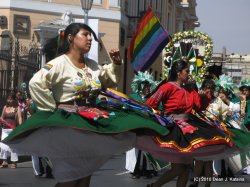
The next day we headed to the centre on a bus and en route passed by a few of the bus lines with service to Cuzco. Ty and I split up to compare times and prices and I found a man on the street selling pomegranate! This city just kept getting better and better. We bought our tickets for the next day to Cuzco, leaving at 3 PM and supposedly arriving at 11 AM the next morning (a 20 hour bus). Then we taxied the rest of the way to Plaza de Armas just in time to catch a parade going by for Cross Day, some sort of religious celebration here that the Catholics used to win over the natives by tying the Christian cross into the Southern Cross constellation, which the Inca worshipped. From there we walked around the centre which was pretty decent and certaintly worth a visit. They have a fountain park not too far away from the centre that I really wanted to photograph at night as I’d seen photos and it looks beautiful but as you already know, we had other plans. Mara, who had been meant to meet us for lunch (but showed up late and didn’t feel up to it), was supposed to meet us at 3 to go to the party at 4. So we had to truck it back to the hostel only to have her not show up at all. No problem, I played piano for an hour or so then we called the friends who had invited us to the party and made our way out to their place. We waited to be picked up at a mall with a tasty bakery and both had a piece of cake to quell our stomachs while we waited with wine bottle in hand.
Mery and Rodriguo picked us up and brought us back to their place where we met a friend and the beer flowed freely. I don’t know how, but they never seemed to be in danger of running out. We had a great time visiting with them, practicing our Spanish, and I wish we had more time to hang out with them. We moved from beer to drinking Pisco straight-up and then some other liquer that was sweet and strong and had a faint taste of apple and a consistency of warm maple syrup. Delicious. Then we went out for... Chinese food; not my choice especially in a city like Lima, but we were guests after all. Moreover, and over our arguments and protestations, they insisted on paying for it which, considering we had only met them the night prior and surely come very near to depleting their beer reserves was exceedingly generous. More and more I find the people here a lot more warm and friendly than their Ecuadorian neighbours (who weren’t exactly terrible to begin with). It was home time yet again and we said bye to our new friends. So many travellers you meet skip Lima and I could only think what a shame that was as Ty, Virgilio, and I headed for the bus terminal the next day at 2:00. Cristina was already gone, making a beeline for Chile and Virgilio was on a different bus but also heading to Cuzco and all of us were leaving Lima too soon. Not for the first time in Peru, I found myself saying that I’d probably be back someday. At least I hope so.
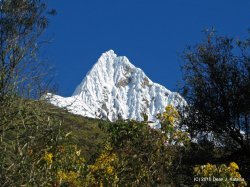
I arrived in Huaraz from Trujillo at 7:30 AM fairly rested from the overnight bus. Huaraz is a city in the heart of the Peruvian Alps, high in the mountains (3100m high, to be exact) and tucked against the Cordillera Blanca (The White Range), a collection of mountains that make 6000m look quite commonplace. This is also a paradise for trekking, rock climbing, and when you’re stiff and sore from these activities, you can head for the thermal baths, too. I was here on somebody’s recommendation that one of the top 10 treks they had ever done could be found from here; I think if you’re at the point where you can select 10 from many more treks, you probably know your stuff. I had a recommendation from different travellers to stay at a hostel called Caroline and so I called them for a pickup from the bus station which is always a nice touch. It’s a bit out of the way (6 blocks at least) but the price is right (13 solas with breakfast), the people are friendly, everything is clean, and the showers/beds are pretty nice. I arrived just in time for breakfast and after sitting outside on the patio and enjoying the beautiful views of some snow-clad mountains, I moved inside for a cup of tea and to sit with some people talking about trekking. I found out there are TWO major treks from here, Santa Cruz and Huayhuash, four days and nine respectively. So now I had no idea which trek was that “top 10” one.
Of course I immediately gravitated towards the Santa Cruz trek. Four days gives me more time for other places and really, nine days is a LOT of time to be in the wilderness. At the table, aside from an incredibly beautiful Aussie girl who unfortunately was going the opposite direction, were a Spanish and Israeli girl looking to price out a trek for tomorrow. Well, there’s power in numbers so the three of us – after talking with the hostel’s travel agency – set out to do some price checking and bargaining. After a lot of looking we found a pretty legit company that would do the four day trek for $70 including a sleeping bag rental for me, two guides, donkeys to pack our gear, and a donkey driver. Considering most places were charging $100, we did pretty well I think. We made our booking and walked around Huaraz, looking for somewhere to have lunch: we found a little food market street and tried some Pachamanca which is basically a combination of marinated meats wrapped in banana leaves and cooked underground. The marinade was almost like a pesto sauce and it was served with a sweet potato and tamale. I was again reminded that the food here is pretty darned good. Usually. After a bit of relaxing and chatting with the mom that owns the hostel for an hour or so, the three of us went for dinner. We skipped over my first choice and ended up at a “Chinese” restaurant that probably has the world’s worst Wonton soup. I actually wonder if the owners are even Chinese, as the wontons were basically unspiced meat balls in almost-raw dough.
The next morning we were up at 5:30 AM to head out on our trek. There was another guy on our trek waiting as well at the hostel named Ty from Denver. We got along instantly. The three of us loaded into the van where we met the rest of our trekking crew. There was a Spanish-Australian guy named Virgilio who was pretty great and then a bunch of Israelis. They seemed like nice enough guys when they would speak in Spanish or English but as that was pretty rare I never found out their names. It was like they were on a different trek than us, anyway. Sure they’d be in the food tent for breakfast and dinner, but they’d talk amongst themselves in Hebrew. When we were actually trekking, they were always at the back, and we’d see them only when we’d stop to wait. Then they’d arrive, we’d set off again, and we wouldn’t see them until the next stop. In all, there were ten of us which meant we had private transport. That should have been a plus, but the drive to the beginning of the trail should have taken 3.5 hours but with our extremely slow driver it took 6. Even our guides, Nilson and Lydia by the way, were getting angry. We arrived at 1 PM at the start of the track, threw together our gear for the donkeys and set out. After passing some farms set in a beautiful countryside we said goodbye to civilization and hello to increasing cloudiness.
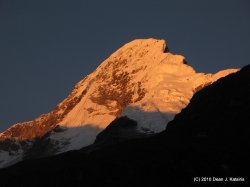
This was unfortunate as our second day would have been lined with white peaks soaring over 6000m as we ascended a green valley below to reach a mountain pass at 4750m. Still, we weren’t entirely unlucky: the clouds did nothing more sinister than drizzle and even stepped aside from time to time to allow us a mysterious glimpse of these massive mountains. As the day progressed and we moved up into the mid-4000s, the clouds grew still further apart and there were even patches of blue. And what we could see of the peaks around us was truly incredible. This is the second highest chain of mountains in the world, after the Himalayas, and here we were walking among giants. We came up to the pass, the altitude now slowing us quite a bit, and as we stepped through the small “v” notch in the rock the view on the other side of the valley awaited. To the right, an emerald lake held in place by a lip of scree from the glacier’s younger days; it now angled down at the lake menacingly as if to warn it may strike at any moment. Off in the distance was another lake in the middle of a green valley weaving its way through the mountains. This was the path that we would take in the next few days. And on the left was a collection of peaks that had all the signs of being really high, though nobody knew for sure with the cloud there. Naturally, we got a group photo at the highest point in the trail and had our so-called lunches before descending to the other side of the mountains.
Having just come from two weeks in the Galapagos, two days in Huanchaco (both at sea level), separated by three nights in Cuenca (at altitude) and one night in Huaraz I was feeling the altitude. The headaches were manageable but now I had lost my appetite and developed a fever. When Ty and I got to base camp there was popcorn (which I still managed to eat a fair amount of) and hot tea. As I sat there I started shivering more and more violently though I was burning up and excused myself to lay down before supper. I never bothered getting up again that night although, another altitude problem, I didn’t sleep a single minute from 4:30 PM when I laid down until 6:30 AM when we got up for breakfast. Ty was kind enough to bring me a bowl of soup which I managed to get down and a bowl of spaghetti that surrendered about eight bites to me before emerging victorious. I also heard everybody getting excited that the clouds had cleared and the full moon was lighting up the peaks beautifully and then playing with the headlamps to spell out Peru in slow-shuttered fun. I didn’t entirely miss out, though, as I had to get myself out of bed around midnight when everybody else was asleep for a bathroom run and a quick vomit. They had been right, the mountains in the moonlight were beautiful. My fever was now gone or at least low enough that the night’s cool felt pleasant and I stayed out there for about a half hour watching.
By morning I was feeling sore and more bored than I can possibly describe, ready to just get up and start walking. My spirits were lifted, however, by the fact that when I unzipped the rain fly, the mountains were lit in gold lighting and the sky was that shade of blue you only see after a good rain. The trek was meant to be four days but the next two days were all downhill and pretty relaxed and a few people (myself included) wanted the extra day for other things. However, my main reason for wanting to do the rest of the trek in one day was just to get out of the altitude and cold and discomfort of the tent and get some sleep. So five of us left the Israelis (and Nilton) behind and set out at 8 AM. Lydia guided us past the tricky water crossings (including one knee-high ford in frigid glacial waters) and then also said farewell to us. We walked pretty fast – as fast as I could manage, actually, and wound our way out of the valleys and back to a small town named Cashapampa by 2:30. At that point, I was beat. I slept, for the first time in a couple days, the whole half hour down to a bigger town from which we caught the three hour collectivo back to Huaraz. I was definitely feeling better as we descended though still exhausted and lacking appetite.
They welcomed us warmly back to Caroline Hostel and after ordering in some wonton soup from a different place (better but still not wontons) and trying to watch the terribleness that was Once Upon a Time in Mexico, I had what may well have been the best sleep I’ve had in South America. The next morning my appetite had come back a bit more and Teo, Caroline’s father, gave us a ride to the bus station to buy tickets to Lima for that night. On the way back, we stopped on the main east-west street running through Plaza de Armas for some ridiculously delicious papabarillas, deep-fried mashed potato wrapped around ground beef, egg, topped with mustard, mayo, picante, and served with an onion salad. The previous day it had taken me half an hour to eat 2/3s. Today I ate two in 10 minutes. Back at the hostel we hung out with an English couple that were really friendly and shared my taste for cheesy comedy on the TV. Eddy Murphy as an alien named Dave? Hilarious (at least for the first hour). Teo again drove us to the bus, Caroline hugged us goodbye, and the mother gave us both a kiss on the cheek. When we got out of Teo’s car he asked us to recommend Caroline Hostel. Of course we would. I wish I had time for Huayhuash, the other trek here, but Santa Cruz was beautiful in spite of altitude-related difficulties. Now I feel fine and am happy to be on the road again, heading to another new place.
At 5:30 in the morning I said goodbye to Bjorn, my Icelandic co-traveller for over three weeks as he left to catch his bus north to Quito and plane onward to Spain. I would be saying goodbye to Ecuador, a country I’ve spent the last month and a half being surprised by, six and a half hours later when I would arrive at the Peru-Ecuador border. My bus to this farewell left at 7:15 AM and I didn’t bother going back to sleep when Bjorn closed the door behind him. I got up, sorted my things, tried to make some progress on my Galapagos photos and blogs and finally headed to the bus station myself. Once again, there was no need to barter taxi prices – the driver just gave me the right price. The bus ride was just shy of 5 hours to the border, which is reputed to be the worst border crossing in all of South America. I can see how that would be the case, if you did it on your own and had to organize transport from the dodgy border towns to the immigration stations but my bus company brought me right to the Ecuador border where I did my paperwork and spent half an hour in no-man’s land before being picked up by a partner bus company, CIFA, and taken to the Peruvian one. The river you cross to enter Peru is pretty unimpressive as far as country-forming boundaries go, but soon enough I had my Peru stamp and was on my way to Piura, a crossroads town in northern Peru where I thought I’d spend the night.
Crossing to Peru was a different world. Somehow, the flooded/irrigated farm fields of southern Ecuador had morphed into dry desert that took me straight to Africa: or at least, what I thought Africa might look like. There were the occasional sparse-but-spread-out trees of the tundra and as the clock marched forward, an orange ball of fire silhouetting their shapes into my memory. If I had seen a herd of giraffes galloping by I wouldn’t have thought twice. The sun set and the clock said 6:30 when I finally pulled into Piura. Here I was to find three major differences with Ecuador that I wouldn’t necessarily like. The first is that there don’t seem to be organized bus terminals here. Instead, each bus line has its own depot which makes it very frustrating as a traveller trying to shop around and find busses leaving at more convenient times. The second is that long distance travel here tends to happen solely at night; Great for saving time (they’re too expensive to really consider them as saving money on hostels) but bad for missing scenery. And finally, for some reason, ALL the bus companies set out at the same times. There are, for example, four companies that do the route from Piura-Trujillo, the next major city on the Pan American Highway south. All of them leave at either 11 PM, getting you there at around 5 AM, or 2 PM, arriving around 8 PM. A bus at 2 PM is a waste of a full day on top of arriving at night, and a bus at 11 PM is OK if you’re trying to save time but not see scenery. And there were no other times on offer.
So I did what anybody would do in my position – I added another 6 hours to my already 11 hour bus ride. I had nothing I wanted to see or do in Piura, so I might as well get while the getting was good. That just left me with a few hours to kill in town, so I took a taxi to the centre and found one advantage that Peru has over Ecuador: food. First of all, the beer I had was a white/wheat beer of delicious proportions. And then the ceviche came and was second only to the ceviche I had in Bogota (but at 1/3 of the price and for triple the portion on top of that). While I waited for my meal I had my computer out and discovered a really fast Wifi network from which I could download a couple episodes of the latest season of Lost and things were looking up. I had something to watch while I tried to fall asleep and, well, let’s face it, the final season of Lost has been simply excellent as it reveals answers to long-held mysteries and advances the plot simultaneously. The streets of Piura were pretty busy, although I guess it was Thursday, and the streets were filled with bustling shops and shoppers not to mention diners and revellers. Maybe I had sold this place short? But then as I looked around I realized that if you weren’t shopping, there wasn’t much else to do around here. I caught a taxi back to the bus station where I waited the final bit, then got on the bus. That is, after an argument with the police in which they insisted on fingerprinting me and I eventually relented in spite of being very unimpressed. Thanks, Peru. I should have given them my middle fingerprint I guess.
The bus ride was uneventful (thanks, I can only assume, to the fact that they had all our fingerprints) and the sleep surprisingly decent but short. The guy who dubbed Clint Eastwood’s voice in Million Dollar Baby kept cutting into my attempts to drift off with “as-KEYR-dah”. I woke up at 5 AM in the dark and groggy in Trujillo. The bus company I’d come down with had no continuing busses to Huaraz, where I wanted to end up, and so I had no choice but to take a taxi to another bus line. Except that, one after the other – four in all – they were all closed. He managed to find out that there were no busses to Huaraz until that night meaning I had a day at the minimum to kill in Trujillo whether I liked it or not, not to mention time to wait for the bus stations to open. The taxi driver must have known they were closed but he protested his innocence and then asked for more money because he’d taken me to so many places. I’d had him bring me to the collectivos heading to nearby Huanchaco, a beach town that was supposed to be decent. If I was going to lose a day I might as well enjoy it properly and lose it somewhere nice. But the collectivo wouldn’t wait for me to negotitate a fairer price with the driver and I had to eventually just throw him his 10 solas (double the agreed fare) and hop on.
Thankfully, Casa Suise in Huanchaco let me check in ultra early and I napped until 9 AM in my bed. I had to take a bus back to Trujillo to book my overnight ticket for the next night to Huaraz which took longer than I would have hoped and came back for some great lunch (lomo saltado, basically stir-fried beef with onions, for 5 solas/$1.75 with rice and fries) at Restaurante Maria or something like that on Los Pinos. Finally, I got to the beach and laid there alternatively reading my Spanish notes and watching the surfers. I played with the idea of getting in the water but it was shockingly cold for this close to the equator and I just wasn’t in the mood that day. After a shower I went back out to find a place to have a beer and watch the sunset though there were no stores along the beachfront. I had to ask a couple Argentine guys where they got theirs from and then I came back and they were gone so I sat on the rocks and watched the sun drop in unison with the amount of beer in my bottle. They had apparently gone to get more beer and returned to join me and we sat there for some time, dipping into their reserves and then bought yet more, meeting a cool mix of Ecuadorians and traveling hippies on the street as we did so. I had to go back to the hostel to change for the night and made the mistake of laying down. When I woke up it was 3 AM and I had missed what probably would’ve been a great Friday out. But I guess I needed the rest to recover from the overnight bus and what’s left of this cold.
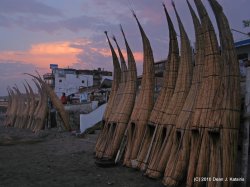
The next day was equally lazy; I sat on the beach and watched the surfers some more and the fishermen in the distance. The town is pretty much a fishing village with great surf and the fishermen paddle out in these bundles of sticks fashioned into the front half of a boat and fish beyond the surf break during the day. When they’ve caught enough, the paddle back a bit and catch a wave, surfing their catch all the way to shore. I sat in an overpriced restaurant on the shore and drank some great Peruvian beer and ate some fresh mixed ceviche. If you had to kill a day or two waiting for an overnight bus, I reflected, there are worse places to do so. Back at the hostel, I caught up on my Galapagos photos and blog (finally!) and then went out for dinner to the same place I’d had lunch the day prior. I was joined by a mixed group of cool people from all over the world not long after I sat down and I thought how cool it would’ve been to have a big group like that to hang out with again. The last time was in Nicaragua and that country is still a highlight on this trip. Still, a little alone time here and there is good and I suppose I’ll make a bigger effort when next I settle somewhere for more than a day or two. I caught a bus to Trujillo and made it with about 20 minutes to spare before my overnight bus departed. Then I was off, into the moonlight, watching The Big Lebowski (I finally realize how great this movie is!) and Transformers 2 (which, simply, is terrible) before falling asleep.