I spent a day recovering from the climb to Cotopaxi’s summit at the Secret Garden and then set off the next morning at 11 for Baños. With me was Bjorn, an Icelandic guy that had also done the trek. The Secret Garden shuttle dropped us off at Machachi and from there we waited on the Pan American highway for a bus heading south and rode to Ambato where we taxied to the other terminal and continued on to Baños. We had been recommended a hostel called Plantas y Blancas (lit: Plants and Whites) and found it a short several blocks from the bus station. The dorms were decent and definitely spotless. Upstairs, a terrace with a breakfast cafe, $1 beers, and games from backgammon to awari awaited. Downstairs, for those so inclined, were steam baths and other spa-related amenities. Of course, having just arrived, we stowed our stuff (lockers would be welcome here) and looked around outside the hostel. The first thing you’ll see when you walk the streets of Baños are row upon row of buggies, quads, and small jeeps for rent. Next are the men whipping toffee by hand in doorframes of candy stores. Travel agencies are lined with photo mosaics of everything from Cotopaxi/Chimborazo to Amazonians in loin cloths and unlucky travellers caught squatting in the wilderness. Navigation is never difficult as the town is flanked by tall mountains with a waterfall on the eastern side and a virgin blessing the town from the hills over the west. Despite its tacky tourist charms, I had a feeling I was going to like it here.
Aside from $1 beer on the patio, the first thing Bjorn and I decided to do was rent a buggy for a few hours to explore the numerous waterfalls on the road west of Baños. Everybody here says you only need three or four hours – but that’s if you don’t want to get off and actually do a bit of walking to see the actual waterfalls. Not knowing this, we negotiated a pretty good rate for three hours of $20 but as soon as we hit the road in our buggy it became apparent that 3 wouldn’t cut it. In the end we paid $7/hr for 5 hours which was still pretty decent. We didn’t plan it but somehow each waterfall we visited grew in impressiveness. The first stop was a double-fall with a really fast cable car to the bottom. From what I’ve heard, this was more of a rush than the white water rafting here. You can also opt to take a different cable car which actually takes you our directly above the waterfalls and stops there to give you a dizzying view straight down. We also passed an old bridge with swing jumping – which is to say bungee jumping except you swing out into a ravine after a bit of freefall instead of falling to the bottom and bouncing back up. We put that on the todo list for our return and motored on. The route takes you on small paths outside the network of tunnels on the main highway so you can see how beautiful the area really is and Bjorn and I took turns driving the buggy up towards the final waterfall of Machaya.
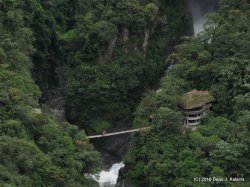
Machaya was beautiful – a really spectacular waterfall from great heights into a valley far below. We walked down to the bottom in a light drizzle only to arrive in pouring rain which only served to fuel the waterfall further. At the bottom there were “Jacuzzi” tubs set along the riverbank, an unused and dull looking ‘canopy’ tour, and yet more views of majestic Machaya. Then we basically ran back up to the top in a record-setting 10 minutes and tried to dry off in a small cafe. We had saved Pailon del Diablo, a very impressive looking beast, for last but now it was raining really hard. We shrugged it off and set out in our buggy once more, finding that the rain abated as we approached the Pailon. Again we descended, crossing a high suspension bridge and finding ourselves face to face with the most impressive waterfall yet. It had carved a pillar of rock out of the cliff face and bounced like a pinball between the cliff and the rock pillar. There was a staircase up for closer looks at the waterfall and beyond that you could crawl up a small cave to emerge literally at a viewpoint near the very top of the fall from which you could reach out and touch the water roaring past you. A few more stairs and the waterfall was over top of you and all you could see was a blanket of white. In the end, the day exploring the countryside around Baños turned out to be one of adventure and Bjorn and I were happy we’d opted to do this.
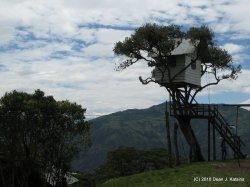
However, we were chilled to the bone but in a town called Baños this is easily remedied. At 6:00 we headed to the hot springs with our kiwi roommate, Berin, and an English girl named Sarah. After alternating between really hot and really cold water several times we felt brand new and invigorated. We also met some people who’d heard of us from the Secret Garden in Cotopaxi and whatsmore were traveling with two Saskatonians named Rich and CJ. I met them the next morning after introducing Bjorn and Berin to three-player pool and cutthroat and also a rousing game of foosball with the owner of one of the bars who really did love her foosball. She practically had a holster for the WD-40 she carried around and her team never lost. Anyway, the Saskatonians seemed pretty cool though I didn’t get to spend much time with them. After meeting them and having one of the delicious if slightly pricey Plantas y Blancos breakfasts (mmm, double pancakes) Bjorn and I set out on a hike into the mountains standing above Baños. That is, after we were accosted by what I’m pretty sure were fake “immigration officers” demanding to see our passports – which we obviously claimed not to have on us. We made our way up and up and all the way up to the treehouse from which there were commanding views of the nearby volcano, Tungurahua. It was also a good place to have a snack, a drink, and sit watching the clouds slowly clear off the peak. From there we made our way back down, past a lady who was very upset I’d taken a photo of her home (nobody visible in the photo) to the virgin and finally back to town. The whole trek was about 6 hours and tiring but worthwhile.
Though we regularly breakfasted at the hostel, lunches were either sandwiches or else taken from the market building which had really nice set lunches for practically nothing. We were the only tourists eating in the place when we went, which is pretty impressive for a town with as many tourists as Baños. And if we thought it was bad earlier in the week, the last night was the beginning of Easter and was downright nuts. The streets were lined with people in sleeping bags waiting for church at 6 AM. We went out for one last night on the town with a sort of quirky American guy named Scott and also met a few American girls. Finally, Bjorn and I caught a bus out of there to Riobamba the next morning, but not after wandering the town and seeing everybody in all-out party mode. Cuy, or Guinea pig, was roasting everywhere (this is a holiday delicacy) and the candy shops were swarmed. Religious icons were being snatched up by the dozen and the streets were more alive than anywhere I’ve seen since perhaps Asia. But, though I felt funny to be leaving a place at the height of its popularity, we had covered everything I wanted to see there and we had a pretty good plan in mind which was to go to Riobamba, mountain bike the next day down Chimbarazo, and then take the lengendary Devil’s Nose train towards Guyaquil where we’d hopefully catch a flight to the Galapagos islands. So we can hardly be blamed for setting off that morning – and Riobamba would hold its own surprises Easter weekend too.
The jeep bounced and plodded up the rocky road as its prey grew larger in the windshield. In the back, four men sat sideways facing each other but none dared allow one eye to stray from their quarry. Cotopaxi. The highest active volcano in the world. 5897m of fire, ice, and boulders thrown like grains of pepper across a dirty tablecloth. There was Bjorn, a 23-year old Icelandic explorer. To him, volcanoes were a fact of life... but he looked nervous now, playing his index finger across his bottom lip. Next to him sat Paul, a Scottish born Englishman who had been living in Quito for the last four months acclimatising and preparing for this day. His face was placid behind a mask of stubble but the clench in his jaw could not be hidden so easily. Dan, another English gentleman sat next to me and coughed nervously. Of all of us, Dan seemed the most uncertain of what lay before us and also the most confident. His friend had climbed it and shown him photos but thanks to the scattering of cloud above he had never looked Cotopaxi eye to eye. For my part, I had spent several days in Quito climbing viewpoints and volcanoes before coming out to the Secret Garden, Cotopaxi to do some higher altitude trekking. I had even climbed to the bottom of the Cotopaxi glacier to assess my chances against such a monster. I’d left confident but was returning tense and uncertain of my wisdom. Finally, the jeep could go no farther and we abandoned it to walk uphill to the refuge.
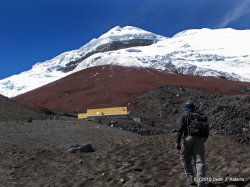
The trek really began around 1:00 PM. We left the jeep hiding in the shadow of Cotopaxi and, laden with all our gear including food, sleeping bags, crampons, and climbing equipment, we set off for the refuge. One step forward in the loose red sand was matched by Cotopaxi with a half-step push back down the hill. Fully loaded like this it was a slow and ponderous climb to the refuge, hidden over 1 km below the summit at an altitude of 4800m and the battle between the four men and Cotopaxi waged on but was eventually won in favour of humanity. At the top were other foolish mortals attempting the climb. The refuge smelled of hope, fear, and unlaundered long johns. The top of the refuge was at times three levels deep with bunks and I was surprised to find they were almost all full. A group of 20 Ecuadorians – men and women whom had lived here their whole lives – were going to attempt to climb Cotopaxi that night. We claimed four remaining bunks and suited up in our ice climbing gear. Jose, one of our two guides, had made lunch which was delicious and welcome in light of the work hauling everything up here and then Marco, the other guide, took us up to the glacier to work on drills. We strapped our crampons onto our heavy plastic boots and set foot on the glacier. It wasn’t my first time ice climbing as I’d done some previously in New Zealand, but it was entirely different. We learned how to walk up and down on varied terrain and slopes, how to fall, and how to climb. Marco would brook no nonsense with photography as the things he were teaching us might be the difference between life and death but eventually offered to take our cameras if we did well. We did.
After drills and skills we retreated back to the refuge. Jose now had dinner ready and we were ready for it too. The nerves that had shaken us earlier in the day were forgotten now as the task was upon us – the only thoughts were of eating, getting some rest, and getting up at midnight to set out for the summit. By the time dinner was conquered it was about 7:30 and thanks to the altitude I managed to get a healthy three hours of sleeping in. I woke up at 11 PM as the first of the groups began getting up and setting out. Bjorn never slept, I later discovered, as he was nauseous and already in the throes of altitude sickness. With the number of people climbing, the groups had to be staggered and we had somehow drawn the short straw with a late departure. The reason you leave at midnight is not to catch the sunrise at the top but rather because a melting glacier is a dangerous animal. The goal is to get up to the glacier and be off the summit and heading down to the bottom by 7 AM so that you are not unlucky enough to be swallowed by a crevice or buried by an avalanche. Our departure was slated for 1 AM which meant we’d be one of the last on the summit and would have little time for any diversions.
We had our midnight breakfast, specially designed to release energy immediately as well as delayed for our hike when we’d need it most. Chocolate, pork fats, soup, fish, and cheese awaited. Upstairs it was time to don our gear: A thin and thick pair of socks to both insulate the feet and prevent the build up of heat and sweat. A pair of waterproof pants worn over fleece thermals. A long sleeve thermal top with my alpaca wool sweater on top followed by a fleece jacket and then a waterproof and windproof one. Balaclava. And finally two pairs of gloves – a thin inner pair and a puffy and wind resistant outer pair. My inner pair had, like my sweater, been bought in the Otavalo markets but now one glove had inexplicably gone missing. I searched everything there was to search and the only explanation I can come up with is someone had a similar pair and took mine thinking it his. I was left no choice but to commence the climb short a pair of gloves. And this was only the start of the bad luck. We were behind schedule, it was 1:15 AM and we needed to get going. Up and up and up we climbed in the darkness, the way forward lit by a nearly full moon and our LED headlamps. Looking up was a daunting task not only for the energy exerted by the neck muscles but also because you could see streams of headlamps far higher and far further than you.
The walk was beautiful up the red slopes to the bottom of the glacier. The orange lights of Quito could be seen clearly through patches of cloud lit blue-gray in the moonlight. Further off, a thunderstorm flashed, lighting the mountains around the contained it like a witch’s cauldron. The moon was bright and never seemed more near nor clear. But there was little time to enjoy that. I was out of breath and the pace our guides were setting to catch us up to the others was frankly more than I could handle though I did my best. At last we reached the glacier and I stole a quick two minutes to grab a few photos of Quito not to mention the other groups we’d caught up with staging at the glacier’s edge and securing their crampons like Jaws’ dentures to their boots. Here, we broke our foursome into two groups. Marco took Paul and Bjorn and they left first, while Jose stayed behind with Dan, myself, and the terrible crampons I’d been issued. As Marco had reacted earlier, so too did Jose. “These are yours?” he asked me. “Nope, they’re from you guys,” I replied only to hear a muttered “Que mal” under his breath. How terrible indeed. We at last set off on the glacier and wound our way up steep and narrow tracks in the snow and ice. At what is likely the steepest bit of the whole walk the crampon on my left foot skewed itself off my foot. I managed to climb one footed to a nearby flat point and we refastened that crampon then set off on the steep paths again.
The next malfunction was my other foot not many steps further up the glacier. Jose didn’t bother to conceal his thoughts under his breath and re-fastened the left crampon to my foot on the steep slopes while I concentrated on not sliding down to my doom with only half the usual grip. In all honesty, such a slide would not have been my doom, or at least not probably. We all wore harnesses and were roped together so that there was not much space between Jose, who led us, myself, and Dan at the back of the chain. In the event that someone should slide or fall down a slope of crevasse the other two would hopefully have grip enough to arrest the fall and help get the victim back on track. That is, assuming that the harnesses worked better than my crampons were that evening. It was maybe only thirty minutes more when my left crampon completely fell apart. Somewhere a screw that held the expanding joint in the bridge of the foot together had worked itself out and was nowhere to be found. Dan squatted beside me, no doubt annoyed as much as I was and Jose surveyed the damage. Unlike the last times, he was sad this time. He looked up at us and said, “We can’t go to the top. Not with this. I’m sorry guys”. Dan immediately insisted that we WOULD find a way and we weren’t about to miss going to the top. My brain was hard at work trying to find a way to hold this crampon together but in the end it was Dan and his determination that kept us moving uphill. He removed a shoestring he’d used to insulate his cold metal ice axe and managed to wrangle together a solution.
Jose still looked unhappy. “I’m sorry but even if that holds together, we’re probably too far behind now to make it to the top in time.” This is when I discovered the reason we left at night instead of in the morning. We had a 7 AM curfew. Still, I was determined not to be the cause of failure even if it was the crampons I’d been given and we set out at a pace I doubt I could equal were I to attempt the mountain again with months of training. We made 450 metres more in altitude in so short a time that Jose was impressed and we even overtook another group. This was no easy task and I only managed to draw a full breath every one to two minutes. I had to lobby for 10 seconds here and there to attempt to slow my heart and breathe in and was only greeted with Jose saying “Come on, come on, let’s go” in Spanish and Dan’s more friendly encouragements. My crampon disintegrated again at that marker but we didn’t lose the shoe string. We refastened it yet again with the shoestring but none of us had much faith that it would hold. I took off my camera strap and we used it to help pull the crampon together and reinforce the shoestring and it seemed solid. We made a lot more ground but were racing against the clock – it was looking like we’d just make it to the summit in time when the crampon fell apart again.
Everytime this happened, Dan and I both had fearful but determined looks. We had not gone this far, through so much misery, to be thwarted now. I was at the point of leaning heavily on my ice pick and occasionally even having bouts of dizziness when I didn’t get enough air. Even Dan was tripping over his own crampons (though they held together) from time to time. We managed to resecure the crampon and began our slow step-1-2 step-1-2 pattern onward and upward. The moon had set and it had gone dark but eventually the sky began lightening. In our scenario that was a bad sign as we didn’t have a lot of time after dawn to get to the top. But with more trudging, the end was in sight. We were on the very steepest section of the glacier when the crampon, for one last time, fell apart irreparably. What frustration to be within sight of the top and see others already coming down as we sat what appeared to be 20 minutes from the summit unable to ascend or for that matter descend due to a failed crampon. We tried a thicker string and a sewing kit but there was no hope for it. We were beaten at the last by Cotopaxi. Marco came down with Paul and Bjorn, returning from the summit, and took a look at my crampon before deciding it was worthless. Here I have to credit the guides. It was now most unlikely we’d make the summit by 7 AM (a scant ten minutes away) but instead of insisting we turn and walk down Marco gave me his crampon and descended the whole of the glacier effectively on one foot. Jose led us upward, knowing I’m sure that we had no chance of reaching it by 7.
We didn’t reach it by 7. It was not twenty minutes away but almost 45 minutes away. By the end I was so exhausted by false summits and the strain of the night that I was using my hands and arms to support myself on the snowbanks along the path. Paul had ascended the last 50m on hands and knees. We had passed plenty of others who had not made it to the top. There was nothing easy about this. Still we pressed on and at last I saw the sun hitting the top of the last rise in such a way that it had to be the top. Soon... step, 1, 2, step, 1, 2, we were there. There was nothing above us anywhere, just snow at our feet that melted into cloud as though we were standing on top of some white blanket covering the globe. The sheer exhaustion, the feelings of fighting a losing battle, the frustration with the crampon, and the sheer amount of physical and mental exertion all culminated at once and I felt the feeling that gold medal champions must feel after a long hard season of work against all odds. I was shaking and could scarcely hold it together. I made it to the summit against what felt like all odds and almost collapsed into a sobbing heap of wasted flesh; I was completely overwhelmed and everything I was feeling was threatening to bubble out of me. Soon that emotion was replaced by a smile that grew from one ear to the other and wouldn’t disappear for the next several days. The weather was perfect that morning and Jose gave us plenty of time to get photos and enjoy being at the summit as a result. We arrived as the last group of climbers who’d made it were leaving and had it all to ourselves.
The views from the top were out of this world. The smell of sulphur wafted up from the crater yawning below us, ringed in a donut of white snow. Clouds made up most of the landscape but in the distance other high peaks punctured them to make a really top-of-the-world feeling. There were also breaks and the sheer altitude above the valley where Secret Garden lies was staggering. I have never had vertigo on a mountaintop before but this was the very beginnings of that sensation. Finally, it was time to go and we descended as fast as we could. The descent was dangerous but only getting more dangerous as we waited. Jose wouldn’t allow us to stop for photos but I pulled out my camera and tried to take a few photos on the fly as we walked down – that is, when I could spare a hand from my ice axe. It was a tiresome descent on the legs, especially at the speed we were coming down, and eventually he capitulated and we had a short rest. While I was putting something back in Dan’s backpack, I lost my outer glove to a rogue gust of wind which sent it flying into a chasm. So now I had one hand exposed and had to switch the glove to the hand with the ice pick. We crossed several chasms that had already opened in the warm weather and found ourselves at last over the only one big enough that I had noticed it on the way up. It was a lot more terrifying in the light of day. The bottom could not be seen and a small aluminum ladder was laid across it which is no easy task to walk wearing crampons. Dan went first, took one step and fell straight forward onto the snow opposite. Whew. There he took the rope and wrapped it around the ice pick then drove it into the snow. Next it was my turn.
I got to the edge of the ladder and made a mistake. I looked into the blue abyss of the chasm. Jose quickly snapped at me to look forward and not take my time – the ice was melting and time was of the essence. I stepped on to the first rung. I balanced on one foot and tried to find a place to put my second foot that would be solid and not on crampons then found it and set my foot down. Then the next rung and then I was across. I leaned on my ice axe as I manoeuvred my other foot onto the isthmus of ice. That’s when the ice and snow beneath it gave way and I lost my balance as clumps of ice rattled down the chasm to nothingness. I sprawled forward and landed on solid ice then crawled forward quickly to a thicker part away from the edge. Then I remembered to breathe and found myself shaking as I sat beside Dan looking at the chasm. Again, we had ropes, anchors, and so on, but it was a terrifying experience nonetheless. Jose also helped another group across the dangerous chasm and soon we were all smiling again – another challenge overcome. The rest of the way down was uneventful. Steep, hard, and fast, but uneventful. We arrived back at the refuge looking haggard but successful, packed our stuff, and we were heading for Secret Garden Cotopaxi before we knew it. There, all the people who had been there when we set out on our adventure met us with cheers, hugs, and beer. I looked back over my shoulder at Cotopaxi just in time to watch a cloud hide its face from us. It had nothing to be ashamed of, however; had it not been for the weather, a determined guide and a persistent co-climber, it would have beaten any of us standing there. But the day was ours and I wouldn’t stop smiling for a long time to come.
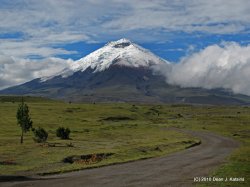
Cotopaxi is the highest active volcano on the planet reaching a height of 5897m (19,347 ft) above sea level. Planes, to put it in perspective, generally fly at around 35000 ft. Despite its home a few dozen kilometres south of the equator, it is so tall that its crown is covered in glacier. It is a perfectly shaped cone of black, red, and white with looks that would make it stand out even without the breathtaking (literally) heights. And it sat outside my window at the Secret Garden hostel, itself resting on the fringe of Cotopaxi National Park. The hostel itself is a bit of a paradise, too. At $30 per night, you are given a warm and comfy bed in their dormitory and a spot around their large kitchen table where the hostel owner’s wife sets gourmet food (she’s a professional chef) every night. Every meal is at least two courses and is either an appetizer and main or main and dessert. Breakfast and lunches are likewise included (not to mention all the coffee, tea, water, or soft drink you can swallow) though they aren’t quite up to the lofty dinner standard. Every room has a fire waiting for you after dinner not to mention a big fireplace and comfy couches around the main lodge. Additionally, volunteers take you on very cheap or free treks up to waterfalls, nearby volcanoes, and more. Jump on a horse and ride to a nice lookout for lunch, take out a free bike on the country roads, and come back to sit by the fire before dinner. It might be paradise.
The Secret Garden in Quito (owned by the same Australian-Ecuadorian couple) does $5 shuttles to their Cotopaxi operation every Monday, Wednesday, and Friday and I found myself in the back of a pickup truck with an Argentinean named Mauricio heading south. He wasn’t comfortable speaking in English so I got plenty of Spanish practice on the way there. In the cab of the truck were an older American couple from near Seattle named Bob and Gayle and another girl from Winnipeg named Stephania. We arrived in time for lunch very hungry to find it ready and waiting for us. Unfortunately, it was cream of vegetable soup – except without vegetables. So lunch was a tasty broth with some warm croissants which tasted great but wasn’t exactly filling. We took off in rain boots 20 minutes after lunch to hike up to a waterfall and were grateful to return to a 5:00 snack. The walk was nice and a great way to get into the swing of things here. The dogs of the hostel, Basil, Milo, Mash, and Daisy all accompanied us as well as Connor, a Calgarian that was volunteering at the Secret Garden. After the snack as the light of day waned Dylan, the other volunteer (from Barrie, Ontario) here got the fire going in the low-oxygen air which is no mean feat. We sat around the fire and got to know all the cool people both living here and visiting with us.
Dinners here are one of the main reasons that the Secret Garden is famous. Monday night was a vegetarian lasagne with a creamy cheese sauce, Tuesday a thai beef curry, Wednesday was meatballs in a peppercorn sauce, Friday Chicken Stroganoff, and Thursday (which I intentionally saved for last) was thin crust pizza cooked in a wood-fired clay oven. Mango chutney, goat cheese, rocket, and a sprinkling of oregano topped one of the pizzas. Chicken, peppers, olives, and a three-cheese topping made up another one of the pizzas, and the third pizza was tomato, eggplant, four cheese, and carmelized red onion. Add to this that Dylan is also a professional chef and conversations about marinating scallops in red rooibos (or blueberry) tea, making Popcorn shrimp with an actual popcorn puree rather than deep-frying, and “root” fries of parsnip, carrot, sweet potatoes and regular potatoes were common among us. Not to mention Duck Confit. Connor once said he could probably get a job as a chef just reciting everything Dylan had said about Duck Confit. He probably right. I guess it’s no wonder I was hungry so often; and they say altitude is supposed to diminish your appetite. All the meals also included an appetizer or a dessert – I’m not sure we had any appetizers but desserts included orange cake drizzled in chocolate sauce, hot chocolate, custard, and so on. It’s lucky that you tend to weigh less near the equator.
The day we arrived was overcast and Cotopaxi was nowhere in sight (especially after a thick fog settled in) but the following morning was absolutely stunning. There was Cotopaxi, as described; right out the window looking like it was painted on the skyline. Breakfast in these parts is at 7:30 AM and don’t worry, I won’t get into it. After, we loaded into a Land Rover and drove to the base of Cotopaxi. Today’s hike was for acclimatization and not to summit the mountain and it was a beautiful day to do it. The walk was pretty slow going up towards the refuge but not hard aside from needing to breathe a lot more than usual. The refuge itself was at 4800m and from there were hiked another 168m to what, at the time, was the highest elevation I’d ever reached outside a plane but sadly 32m shy of the 5000m mark. Coming down was maybe the best part as we basically ran down and let our feet slide in the sand like skis. It was great to half run half ski past tired looking people making their way uphill. Afterwards, it was back to the hostel for lunch and then an afternoon of rest and relaxation in the many hammocks and sofas all around the place. Which, essentially, was the plan for Wednesday as well, except that I brought out the Spanish books and exercises I had with me and studied most of the day. Mauricio left that morning which was too bad as he was a cool guy, into great music, and we got along well in spite of the language difficulties. I gave him some Canadian music and he gave me some cool Argentinean music and also a t-shirt for his favourite band. I offered him my Che Ramon shirt in exchange for this unexpected kindness but he refused.
A whole new group of people were slated to arrive Wednesday which I wasn’t excited about. I quite liked our small and already close-knit group. Bob, I discovered, was a retired electrical engineer for Boeing so you can imagine that we had a lot in common not to mention that his wife was awesome and had been to most of the places I have – except in the 70s when people didn’t do such things. Mauricio was gone but I got along really well with Steph as well though I think she could get along with just about anyone. But the Wednesday crew arrived and turned out to be really great as well; I think some hostels just attract cool people. We added a Korean-Australian named Nikki, a couple Dutch girls named Lian and Daphne, an English girl named Rosemary whom I’d met in Quito, and another couple to our mix. Their arrival was an excuse to finally break out the drinks and we celebrated that night with a lot of Uncle Ron (Ron being Spanish for rum). That night ended at about 4 AM which is really late here but I was up at 7:30 for breakfast and in fact set out on a hike that morning too. I was going with Gayle and Bob on a small loop up into the mountains but as we walked up there – past wild horses and everything – and Volcan Pasochoa loomed overhead I knew I had to walk to the top in spite (or perhaps because of) lack of sleep and excess of rum. So after a snack for lunch I headed up on my own and made the summit.
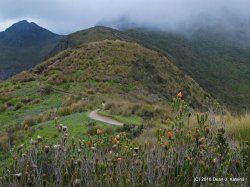
The top was cool. On the side I’d hiked up was a very arid ecosystem that bordered on desert but on the other side of the ridge was lush cloud forest as a result of the fact that the sun only hits the one side of the ridge. The difference is too stark the put into words. You could also see all the way back to Quito (which is apparently a 6 hour hike if you go right over the mountains) and several of the snow-capped volcanoes in the area. Dylan was waiting for me at the arranged meet up point when I came back down and we walked down together quickly to catch the others who’d taken a scenic and flat loop around another mountain. We were back 13.4 km later in time for lunch and to meet yet more arrivals. Friday came and I had to say goodbye to pretty much the whole crew from Monday and Wednesday. Luckily, Steph and Nikki kept me company until the new crew arrived and among the new arrivals were two of my three climbing partners. Paul, whom I'd already met at the Secret Garden hostel in Quito was one of them and the other was an Icelandic guy named Bjorn. So Friday went pretty quickly although I was already getting antsy to climb Cotopaxi. That journey would begin Saturday morning and hopefully end in our return Sunday afternoon.
Quito is less than one degree below the equator and has the distinction of being the first place below the equator I have visited on this particular journey. I know what you’re thinking: hot, humid, blistering sun. You’re wrong about the first two. The city is at an elevation of about 2900m above sea level (or 9500 ft) and while the sun is definitely warm and will scorch your skin the air is cool and even chilly in the evening. And no, it doesn’t warm up at some other time of the year because, being on the equator, there are no seasons. Every day is the same length, every day the temperature is consistent within a few degrees, and every day you have nice and sunny mornings with increasing cloud and maybe rain in the afternoon. Almost. Although it might sound boring, Quito is anything but. Even a walk down the street can be a hair-raising experience as I would soon discover first-hand. My arrival, for another example, was fraught with challenges and unexpected surprises.
According to the Lonely Planet, there are two main terminals for the city of Quito, one near the airport (in the north) and the other just south of the old town. So it was a bit confusing when my bus from Otavalo arrived at some terminal in the middle of nowhere. The bus driver sorted me out, however, by putting me on a bus that said Plaza San Blas, which is on the south end of the old town and walking distance from the hostel I was going to check out. The cost was a bit suspicious, however, as city busses are supposed to cost 25 cents and I was paying $1, half the price the 2.5 hour bus from Otavalo cost. I soon saw why as we wound along freeways perched on the mountainside and wound our way into Quito. Or so I thought. Each time we turned a corner there was a whole new stretch of city. “THAT must be Quito!” And then we’d turn again. The bus reached a roundabout and the driver’s assistant told me I should get out here. Why I’d want to was beyond me as the bus was supposedly heading to Plaza San Blas, but with some discussion it appeared that was not the case. They told me to get on the Trole line which the LP had warned was no place to be loaded with baggage but I took my chances and made my way in the direction of the old town. I realized just in time that the stop I wanted, Banco Central, was only on the opposite line and got off at Hermano Miguel, then wandered up the hill. There, at last, was The Secret Garden.
You Say Party, We Say Fie!
Sometimes getting around is straightforward and sometimes you find yourself in a situation where you have no idea what’s going. At the end of the day, you always make it, of course. Somewhere. My somewhere was the Secret Garden, probably one of the nicest hostels I’ve stayed at... ever. The staff were friendly, the beds were comfy and cozy, the view from the terrace was unmatched, and the food was delicious. Of course, you had to pay for these luxuries, and then add 12% tax on top (everywhere else includes it and it’s pretty annoying that they don’t here). Still, in the end the hostel was $10/night, drinks were $2.25, and meals were about $5 but for some pretty gourmet fare compared to the usual backpacker diet. I had a full sushi roll one night for $3.30, pork chops in fig sauce another for $5, stir fry, and so on. In Quito you have a very distinct choice: party or culture? If you want to party, the area to be is in the new town (AKA La Mariscal) which is surrounded by pubs, bars, and tourist outlets such as travel agents. The area is, however, quite dangerous in the evenings and on Sundays when there aren’t many people around. On the other hand, the old town where Secret Garden is located is colonial and full of local flavour not to mention churches, palaces, and all sorts of interesting architecture. Nights here are likewise risky but not so bad as Mariscal.
Pardon Me, Would You Squirt Me With Gray Poupon?
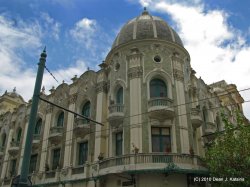
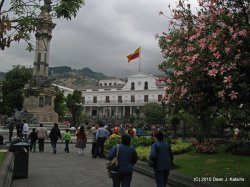
So, the scene has been set. I met a girl from Cincinnati named Kim in my dorm and we decided to explore the old town together the next day. We made our way first to Plaza Grande de Independencia, which was a nice walk along Guyaquil St and past, I should add, a music store with a piano. The plaza was really beautiful and surrounded on all sides by historic and important buildings including the Presidential Palace. It was humming with activity from both humans and birds pecking in the grass and among the flowers and though the weather was largely overcast, it was stunning. There was also a protest in front of the palace against corruption (what such demonstrations hope to accomplish is beyond me but it’s better than violence) and we found out it was possible to tour the palace (with passport) at 2:30 PM. We grabbed lunch on the fourth floor patio of a nearby building ($3.50) right across from the Bolivar theatre, and then started walking back through the old town in the direction of the large gothic basilica that dominates the skyline of this part of town. We were walking along on our way across when I felt something fall from above although in retrospect I’m not sure how this is possible as nothing touched me; Perhaps I just saw it hit Kim in my peripheral vision.
The man in front of us looked confused and at his hands as though he had felt something too. It took less than a second to see that Kim had a line of brown goop all the way down her back and her jeans and realize what was happening. It’s a common scam here to squirt tourists with some condiment or other (mustard is popular as it COULD be bird-related) and then offer to help them with some tissue you just happen to have on you. Usually there are two of you and while one is cleaning – your pockets primarily – the other is distracting you or claiming there is some of mystery goop on your backpack. If you take that off, you’re done for. The first guy distracts you again while the other bolts with your belongings. That they would do this to Kim while I was walking with her is pretty shocking but we were on to it almost instantly and inside a restaurant before they could even reach us. One man stood at the door proffering tissue and I told him to get lost; it happened so fast that I wasn’t certain enough of the culprit to get upset or violent which is probably just as well. They got away with nothing and, unlike others who have managed to avoid the mustard attack only to be mugged or beaten around the corner, they scampered off and left us alone. I helped clean an understandably shaken Kim and we continued our walk to the basilica without further mishap (well, she did trip on the cobblestones, poor girl, but was mostly unharmed).
A View to Time Kill
Climbing the Basilica is probably the single best thing there is to do within the confines of Quito. You climb some rickety spiral stairs and can climb through the crawlspace over the cathedral and beneath the slopes roof to get to the spire. From there, it’s some really open and exposed steps high above the city below to get up the spire to some fantastic views. Back down from there and through the crawlspace again you can climb up one of the two clock towers which due to their height feel even more precarious. I couldn’t help but think about the recent earthquake in Chile and ponder how vulnerable we were so high above the city in this old church. Thankfully, the Earth held itself together and – after a delicious hot chocolate – we made it back to the ground safely. Quito is a city surrounded by volcanoes and hills and so there are no shortage of views here. Another day, I hiked to the edge of the old town and up El Panecillo, a huge angel on one of the nearby hills. You can’t walk up because the base of the hill is ironically very dangerous so from there I took a cab up to the top and looked around. I had the bad luck of doing so on a Sunday so there was no option to go inside the angel but the views were nice. I still wouldn’t say it was worth doing but if you’re killing time in Quito it will pass a morning.
The final viewpoint that I took was up the Teleferiqo, a cable car up to a mountain 4100m above sea level (and thus over 1 km above the city). It’s different seeing things from that high as you lose your depth perception and I actually liked the view from the Basilica better, but I needed to acclimatise for my upcoming hike to Cotopaxi (the highest active volcano in the world at 6000m) and from the top of the Teleferiqo you can hike up to 4700m on an extinct volcano over Quito. The walk was really nice and not too difficult but I had the misfortune of incoming cloud which began to obscure the rocky peak with every step I took in that direction. It too was a great way to pass a day although the ride itself costs $8.50 for foreigners not to mention taxi fare to get there. I took the metro to Colon and took a $2 taxi from there and then split a cab with some Kiwi doctors back down to the new town for another $1. As for me, I probably got to about 4650m or so which didn’t break my record of 4660m in China due to the cloud. I’m told on a clear day you get some great views of the glacier tipped volcanoes in all directions around Quito but clear days are hard to come by in this city any time after 10 so go early. You can get to the peak in about 3 hours from the top.
Journey to the Centre of the Earth
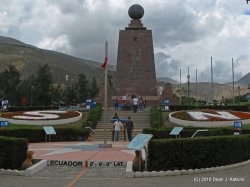
The day after Kim was attacked with mustard and two days before the equinox, we set off for the equatorial line which runs just north of Quito. It’s about 1.5 hours from Quito’s old town view two busses (40 cents) and is also worth the trip. It’s pretty funny that the big landmark and park that they built in the 70s to mark the equator and give tourists something to photograph was put in the wrong place. The actual equatorial line, thanks to the wonders of the US Military and GPS, is actually about 200m away and (I suspect) on some farmer’s land bordering the park. He did what any good entrepreneur would do and built his own kitschy park full of knick knacks and random statues and charged a $3 admission. The original monument (where most people take photos and hope nobody will notice) cost $2 and is a lot cooler to photograph but the mistake we made was looking around the park before someone came to collect our $3 and deciding it wasn’t worth it. We later learned from the Danes in our room (we’d reconciled with them after they were really noisy in the dorm my first night) that we’d missed out. The highlight of the tour is not the kitsch but rather the experiments they perform on the equator. They take a sink, fill it with water and leaves, and then pull the plug north, south, and on the equator and it drains clockwise, counter-clockwise, and straight down respectively; They balance an egg on a nail which, due to the fact that gravity is straight down only on the equator is impossible anywhere else; They have you walk the line with your eyes closed to demonstrate that (apparently) your balance is thrown off while right on the equator. Most of these things have been disputed by scientists so viewing them is quite perplexing. I wish we’d done it firsthand instead of in video form.
There’s not much else to say about Quito. The city grew on me day by day and I wound up staying longer than is probably necessary but enjoying it. I looked into trips to the Galapagos but found nothing cheap enough or with a good itinerary worth booking, thinking it would be good to go do Cotopaxi, return to Quito for the Galapagos, and then continue heading south. Instead, I booked the Monday morning transport (only $5) to the Secret Garden hostel overlooking Cotopaxi. It costs $30/night including all food and non-alcoholic drinks plus some pretty reasonably priced tours and from everything I’ve seen it’s entirely worth it. Cotopaxi sits out the window, covered in ice even here on the equator, looming over the green highlands strewn with cows and farms. From there, I decided, I would head to Banos, do everything in the mountains while I was acclimatised then head to the coast and hopefully have some luck finding a deal to the Galapagos either on the islands themselves or else in Guyaquil, the largest city in Ecuador.
The moment you cross the border from Colombia to Ecuador you start climbing. I was doing so in the truck of a farmer who had offered to give me a lift to the nearby (7km) town of Tulcan as he was going past there anyway. I thanked him any number of times and was grateful not to have had to find the collectivos nor to have walked up this path on my own. In Saskatchewan, they say you can see your dog run away for two weeks because it’s flat. Here, you could probably see your goat run away for about the same amount of time as all you have to do is look up. Finally, we came to the top of the hills and the highlands beyond and the farmer turned off the highway (I offered to walk at this point as going into town was no longer on his way) but he just kept driving. We got to the bus terminal and I thought it polite to ask him if I could give him a bit of cash for the lift. “$1.50,” he answered. Collectivos from the border cost $0.75. So I realized too late that he was taking me for a different kind of ride too and was asking far more that the three minutes out of his way was worth (remember, remember, this is Ecuador and, for example, the 3.5 hour bus ride to Otavalo only cost $2.50). I told him I had no change and gave him the $1 thinking it more than enough but then he went to the bus and asked them for fifty cents which they could get from me when I paid my fare. “Not,” I reflected, “a great welcome to Ecuador.”
I quickly forgot this minor event as the bus drove on and I gazed out at the brilliant hillsides and the setting sun. It was already late afternoon and I was still curious whether the bus ride would be 3 hours or 8 as I’d been told both, but given the price, I assumed 3 was closer. I arrived at last, probably around 8 PM, in the town of Otavalo, on a Friday night. Friday is important because the town is famous (and often booked solid) for its Saturday markets but I figured I’d chance finding a place and, worst case, grab a bus to nearby Ibarra or even Quito (30 mins/2 hours) if I didn’t find one. The first place I tried was full but the second, a hotel rather than hostel, had plenty of space and I got a private room there for $7 which they later bumped down to $6. I hadn’t eaten since the bus station on the Colombia side of the border which seemed quite long ago so after putting my stuff in the room I left immediately to grab a bite. My first meal in Ecuador, accidentally, was Chinese food and I didn’t even have Phil to blame. I ordered a “medium-sized” (LARGE) mixed plate which had noodles, chicken, beef, shrimp, and rice as well as a Coke and the equivalent of two bottles of beer for... are you ready? $3.25. Coming from Colombia where I was spending about $38/day, it was looking like I would be spending about $15/day here in Ecuador and that was very welcome indeed.
As I mentioned, the reason I stopped in Otavalo aside from border proximity was the Saturday markets. In the wee hours of the morning, traders stream in from all the nearby indigenous towns to join their Otavalo friends and set up stalls on almost every street in the centre. Mazes of handwoven wool products are unravelled and definitely are the main attraction, some from llama and others from alpaca, but in addition to this there are all the usual market attractions: paintings, traditional dress, jewellery, fruits, spices, t-shirts, and so forth. I was out and exploring the markets by 9 AM and already they were bustling with activity. The first item I noticed didn’t fall into the usual item category. Hats, hats, and more hats of every shape, style, and colour and in every direction. Panama hats, for example, are actually from Ecuador (each vendor is proud to remind you) and there was no shortage of them here. I left my fedora behind on a bus in Colombia so I was on the lookout but nothing jumped out at me. However, with the higher altitudes, I realized I’d probably need some warmer gear (despite being a stone’s throw north of the equator, Otavalo is at 2550m above sea level and the evenings get cool if not chilly. So I added an alpaca wool sweater, scarf, and pair of gloves to my wardrobe for $8, $4, and $2 respectively.
The vendors were all really friendly and I wound up chatting with a few of them for some time, which was a lot of fun. I always have to look for ways to keep working on the Spanish and getting to know a local is the best way by miles. I also grabbed some blackberry-guanabana juice (mmm, good!) and a few snacks while I walked around and browsed the wares. For lunch, I found a place with a spit-roasted pig’s head smiling at me and decided I’d accept his invitation. Another item of note: a ukulele/guitar that uses an armadillo’s shell as the sounding board rather than wood. Apparently this is quite a traditional musical instrument here and were I heading home from here I may have brought one. In fact, there were any number of items I came across that made me think of people back home but I’m sure there will be plenty more further south and closer to the end. I then walked around what little part of the town wasn’t covered in market stalls, picked up some fresh strawberries, a bottle of water, and went to recuperate. That is also how I spent the following day: studying Spanish and finishing Twilight (I found it at a book exchange and as much as I thought I was on track to hate it at the beginning I found it irresistible by the end).
Otavalo is famous for its markets but aside from that it is situated beautifully for exploring nearby towns, lakes, and the countryside. I mentioned to the hotel manager on Sunday that I was heading around to look at these towns and he said it was his day off and if I wanted he wouldn’t mind getting out of town a bit. After the guy at the border, I was definitely regretting opening my big mouth and asked as politely as possible if he was expecting money or anything. “No no, I just like to go and see the country”. I still wasn’t convinced there wasn’t some ulterior motive but we agreed to meet at 10 AM the next morning and I was kind of grateful when he wasn’t there. It might have been really cool to walk through the hills and towns with a local (or that was my initial thought, not to mention Spanish practice and having company) but I wasn’t ready to be misled again quite so soon. So I set out by 10:30 and made my way towards the town of Peguche, just up in the hills from Otavalo. On the way I had a local woman who was doing laundry in the stream see me and point me upstream to where there was a waterfall. Heading up across fields and small paths I found myself following an indigenous man and then chatting with him en route. He too was very nice and, it turned out, an author of some indigenous book or other about the Quichwa tribe of Inca that live here. And from where I left him at his museum (where he explained the significance of certain symbols in Inca mythology) I soon came across a classroom of young kids playing on the rocks near the waterfall and got to visiting with their teacher.
So I definitely haven’t written off Ecuadoreans despite earlier jokes and even worries at first. The people here in the hills all seemed very friendly and would say hello or good morning unprompted. After the waterfall I found myself in Peguche which was a nice little town and then noticed on my cartoon map that San Pablo, a lakeside town, was along this same road and set out walking. I passed a girl on the road up and asked for confirmation and she said it was, but it was very far. I should turn around and get a bus. But I hate to backtrack and I’d make it there one way or the other so I pressed on. The next truck that came by stopped and gave me a lift up the hill to their hometown of Agato from which I could also catch a bus so it didn’t give me much time to question my stubbornness. Rather than stand and wait for a bus, however, I decided to walk along the road the bus takes and flag it down but by the time the bus came by I was too enchanted with my walk to be interested. Farmers, field upon field of corn, pickup trucks passing by loaded with 20-something school kids, the distant volcanoes poking out from the clouds, and more were on offer, not to mention a nice walk through the countryside. I decided to just walk all the way to San Pablo de Laguna and it is one of the better things I’ve done in some time. I absolutely loved walking from town to town where you could tell that few travellers venture and being greeted and waved at constantly.
When I was in the Otavalo markets I had a little part of me that wondered if all the people really dressed so traditionally or if it was a show for the tourists. Having walked in the middle of nowhere, I can tell you that it is definitely NOT a show. Everybody dresses traditionally, and it is such a stark change from the very modern Colombia that I could scarcely believe it even seeing it. The border, after all, is not all that far away. The only slightly negative thing I have to say about the whole 6 hour excursion was that I got a bit sunburned (it’s usually clouded over by afternoon and rainy so I brought a rain jacket rather than sunscreen). Eventually I came over a rise and there was the lake below me. It still took me quite some time to reach San Pablo but I passed through some other nice towns and walked for quite a while along the lakeside. When I did get there, I was starving and forked out $4 for breaded shrimp on rice with a fried egg, diced tomatoes, and cilantro. It probably sounds better than it was, but it definitely hit the spot after such a big day. I caught the bus back to Otavalo which cost $0.25 and I thought that the travellers that paid the 25 cents to get there by bus as well paid a lot more in missed experience. Well, OK, I never thought that. But now that I’m typing it, it seemed like a good way to cap that adventure. Tomorrow, at long last, I cross the equator heading to Quito and finally the southern hemisphere. But don’t envy me the warmth yet – Quito is the second highest capital city in the world at 2850m. That high, and in the middle of the earth, maybe I can see both poles?